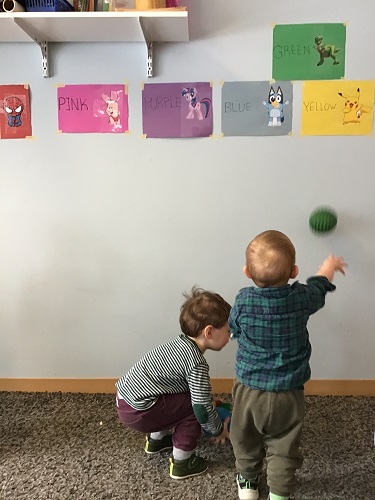
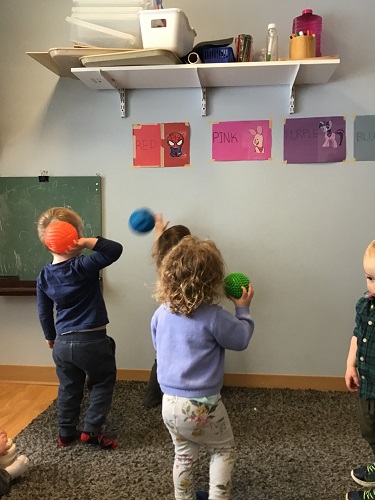
Last week, Jess observed that several of the children were showing a strong interest in throwing toys, often tossing them toward the wall during free play. Rather than discouraging this behavior, she recognized it as an opportunity to build on their natural curiosity and energy. This observation inspired Jess to design a purposeful and engaging activity that would allow the children to safely practice throwing while also supporting their learning and development. She decided to create a target game by printing out familiar characters that the children would easily recognize and feel excited about. She carefully taped these images onto brightly coloured sheets of paper and arranged them on the wall at an appropriate height for the children.
This morning, before setting up the targets, Jess added another layer of learning to the activity. As she prepared the materials, she wrote the names of each colour on the corresponding sheets of paper. While doing so, she invited the children to participate by asking them to guess which colour she was writing. The children eagerly called out their answers, showing excitement and confidence as they engaged in the discussion. This simple interaction not only captured their attention but also encouraged early literacy skills and reinforced their knowledge of colours.
Once the targets were ready and placed on the wall, the children’s excitement grew. They quickly gathered soft balls and began enthusiastically throwing them toward the targets. Some children naturally began matching the colour of their ball to the colour of the paper target, demonstrating their understanding of colour recognition. Others focused on aiming at their favourite characters, calling out their names as they played. Throughout the activity, the children used expressive language, making statements such as “Bluey is blue” or “Spider-Man is red,” which reflected both their familiarity with the characters and their growing vocabulary.
This activity supported multiple areas of development in a meaningful and integrated way. From a physical perspective, the children practiced and strengthened their hand-eye coordination as they aimed and threw the balls. Their fine and gross motor skills were engaged through grasping, lifting, and releasing the balls, while their spatial awareness improved as they judged distance and direction. Cognitively, the activity reinforced important concepts such as colour recognition, character identification, and memory recall. The act of matching balls to targets also encouraged problem-solving and decision-making skills.
Socially and emotionally, the activity created opportunities for positive interaction among peers. The children practiced turn-taking as they waited for their chance to throw, and they showed cooperation by sharing materials and celebrating each other’s successes. The playful and supportive environment also encouraged verbal expression, allowing children to communicate their ideas, label objects, and engage in conversations with both peers and educators.
Looking ahead, Jess plans to extend this activity in several ways to maintain the children’s interest and deepen their learning. She may introduce new characters, shapes, or even numbers to broaden the scope of the game. Increasing the distance between the children and the targets could provide an added physical challenge, further developing their motor skills. Jess is also considering inviting the children to create their own targets, giving them a sense of ownership and encouraging creativity. Additionally, she could incorporate early numeracy concepts by asking children to throw balls in a specific colour sequence, count how many times each target is hit, or sort the balls by colour after the activity.
Through this thoughtfully planned yet simple activity, the children were able to channel their natural impulses into a safe and structured experience. Not only did they have fun and stay actively engaged, but they also developed a wide range of skills that support their overall growth across physical, cognitive, social, and emotional domains.