In the Preschool 1 room, we have been intentionally introducing a variety of loose parts materials to provide opportunities for creative exploration, problem-solving, and social interaction. With a number of new faces in our room, we wanted to observe how the children would engage with these materials, and explore what they could create, discover, and learn through their play.
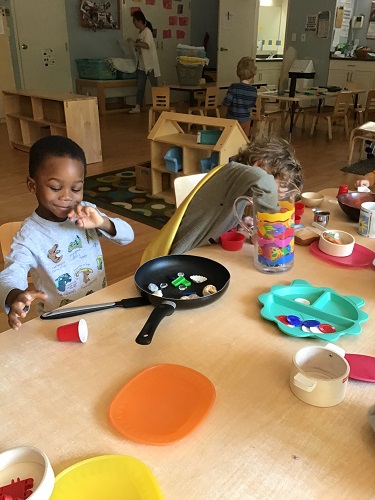
We began by giving the children the freedom to select the loose parts they felt drawn to. Each child’s choice was unique, reflecting their individual interests and curiosities. For example, Penny F chose marker lids, Jackson preferred shells, and Finley was drawn to tokens. As they explored these materials, conversations naturally unfolded, children compared the colours, shapes, and quantities of their selected objects, and engaged in counting how many of each they had. This sparked early numeracy skills, as they practiced identifying numbers, grouping, and comparing quantities.
Next, we introduced small penguins and paint. This allowed the children to experiment with colour mixing and develop their fine motor skills. Finley was particularly interested in creating “fire” with the penguins and the paint, which prompted Penny B to share a story of roasting marshmallows and enjoying a campfire. This moment encouraged the development of literacy skills as the child’s narrative storytelling abilities were fostered through symbolic play.
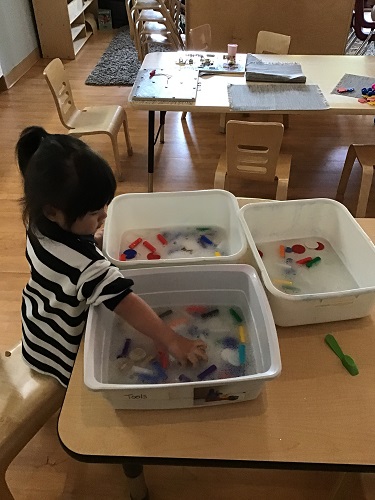
After completing their art activity, we decided to introduce a new element to the children’s play. Our aim was to observe how the children would interact with the loose parts in a liquid environment and see how their curiosity and creativity would unfold.
Leila quickly became captivated by the idea of using the water to interact with the loose parts. She gathered the pieces and placed them in a mug, then offered the mug to others as if it were a drink. Through this simple action, Leila engaged in role-playing and social-emotional development, as she demonstrated generosity by sharing and inviting others into her play. By offering the mug to her peers, she practiced turn-taking and showed an early understanding of social rules and communication.
Hazel, on the other hand, took a different approach. She gathered all the loose parts and placed them into a bucket, then encouraged her peers to come and join her. This action reflected Hazel's growing leadership skills, as she initiated collaboration and invited others to share in the experience. Emma, observing the play with the mug, came up with her own idea. She went to the kitchen and gathered some plates, which she then added to the play. Emma began stacking loose parts on top of the plates to see how high she could pile them. This action engaged her spatial awareness and problem-solving skills as she tested the balance of her structures. By exploring stacking, Emma was practicing fine motor control and developing an understanding of cause and effect she was discovering what happens when objects are placed on top of each other and how to manage balance and height. Similarly, Carina also engaged in the act of piling loose parts, focusing on using her fine motor skills to carefully place each item so that they would stay. This was a deliberate exercise in dexterity and precision, as Carina worked on controlling her hand movements to achieve the desired outcome.
Through this exploration with loose parts, the children demonstrated impressive creativity, collaboration, and problem-solving. They used their imagination to turn everyday objects into tools for storytelling and play. They practiced social-emotional skills by sharing, negotiating, and taking turns, and they began to grasp important math and science concepts such as sorting, counting, colour mixing, and experimenting with different materials. Their ability to connect their play to real-life experiences—such as roasting marshmallows or cooking dinner, demonstrates the integration of their personal experiences with new learning.