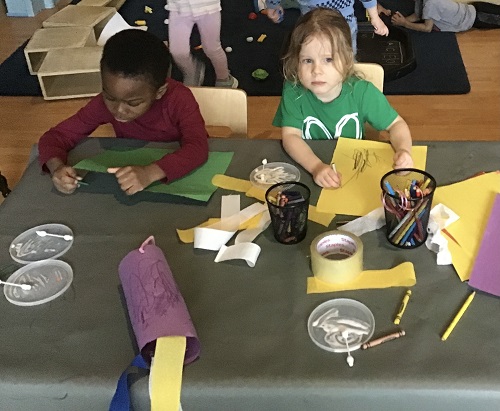
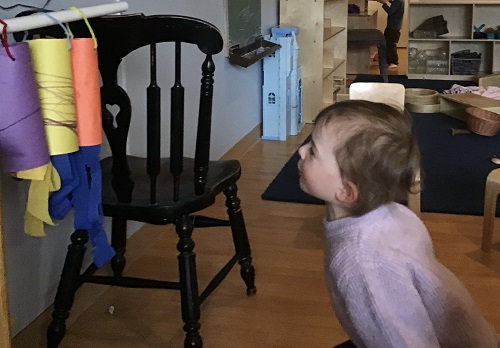
Inspired by a conversation I had with Jayden about wind during pretend play on the playground, the children explored the concept of wind by creating their own windsocks.
Before making the windsocks, we talked about the air we breathe in and out every day and how wind is made when air moves. I asked, “Blow into your hand. What do you feel?” They answered, “Wind.” I then explained that when we blow air from our mouths, we make the air move—and that moving air is called wind. To create windsocks, the preschoolers decorated paper by coloring and drawing. Once finished, they glued tissue paper streamers to one end. After that, pipe cleaners were attached so the windsocks could be hung.
Now, it was time to test the wind. First, the children blew on their windsocks, observing how the streamers moved with their breath. Some blew gently, while others blew harder, noticing differences in movement. Next, they tested the windsocks with a handheld fan, exploring how the streamers moved more strongly and continuously than when blowing with their mouths, and how the movement changed as they moved closer or farther away. During outdoor exploration, the children observed how the natural wind moved the streamers. They noticed that the movement was not always the same—sometimes the streamers fluttered strongly, sometimes they moved gently, and at other times they stopped completely. They also observed how the direction of the wind changed, causing the streamers and windsocks to shift in different ways.
It was a wonderful opportunity for creativity, hands-on exploration, and early scientific thinking, as the preschoolers explored how invisible air can create visible movement.
As a next step, opportunities can be provided for the preschoolers to explore how wind moves different objects, such as bubbles and lightweight materials, further deepening their understanding of wind strength and direction.