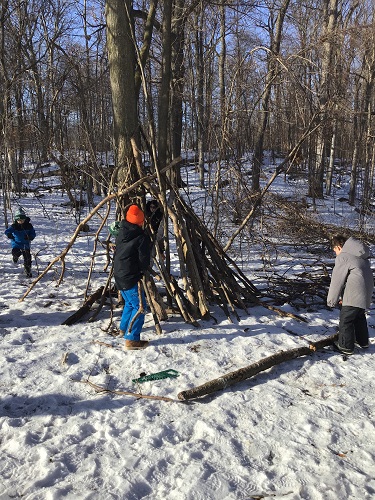
 This past month, what began as a simple forest exploration quickly grew into an exciting collaborative project led by the children. While spending time outdoors, the children began collecting large sticks and logs they found in the forest. Working together, they carefully carried long logs, communicated with one another about where they should go, and problem-solved how to stand them up securely. As their ideas evolved, the children decided to build a hut together.
To support their plan, educators introduced small hand saws so the children could safely shorten logs when needed. With guidance and supervision, the children practiced patience, responsibility, and teamwork as they adjusted materials to fit their structure. Soon after, the group gathered tarps and worked together to drape them over the frame, transforming their structure into a sheltered forest hut.
The children’s curiosity extended beyond the outdoor structure. Wanting to recreate what they had built, they collected smaller sticks to bring inside. Using clay as a building material, they designed and constructed miniature huts, experimenting with balance,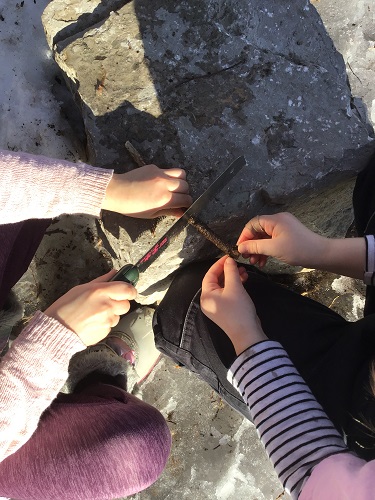 shape, and structure. This experience encouraged creativity, engineering thinking, and reflection on how larger structures are built.
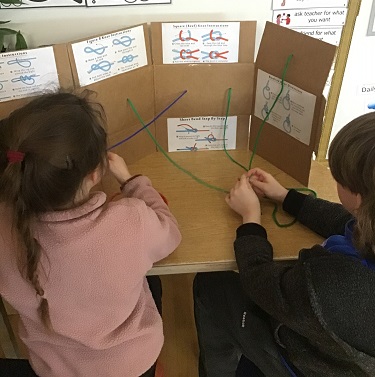
During our outdoor explorations, the children also became interested in learning practical outdoor skills. They explored several different knots, including the sheet bend, figure-eight knot, square knot, slip knot, and bowline knot. The children practiced tying and untying the knots while discussing how each one could be useful when camping or building shelters.
These experiences sparked rich conversations about camping. Several children shared their personal experiences attending camps and trips with Girl Guides of Canada, describing activities such as setting up tents, cooking over campfires, and learning outdoor survival skills. Their stories inspired others in the group and helped build a sense of community as children listened to one another and shared their knowledge.
Together, we explored the topic of campfires and discussed important fire safety practices. The children talked about foods that can be cooked over a fire and shared ideas about roasting marshmallows, hot dogs, and other campfire treats. This excitement led us to create our own pretend campfire experience, where the children worked together to pitch a tent and “roast” marshmallows.
The children also explored navigation and direction. They learned how people can find direction by observing the sun, knowing that the sun rises in the East and sets in the West, and began discussing the purpose of compasses when exploring outdoors. With curiosity and enthusiasm, the children made their own simple compasses using a needle, magnet, piece of foam, and water. They observed how the magnetized needle aligned itself and experimented with finding north, connecting scientific concepts with real-world applications.
Continuing the camping theme, the children created their own lanterns and experimented with flashlight art. By colouring on clear tape and placing it over one end of a tube while shining a flashlight through the other side, the children projected colourful images onto surfaces. This activity encouraged creativity while introducing ideas about light, projection, and design.
 To wrap up the children’s interest in camping and outdoor exploration, we created a Camping Escape Room Challenge. The adventure began when the children searched for and assembled pieces of a puzzle that formed a picture of a campfire. Hidden within the logs of the puzzle was a number code that opened the first lock.
Inside was a bag with a list of camping items—log, rock, lantern, and leaf—each hidden in the space with a letter attached. As the children worked together to find each item, the letters led them to the next location: a tent.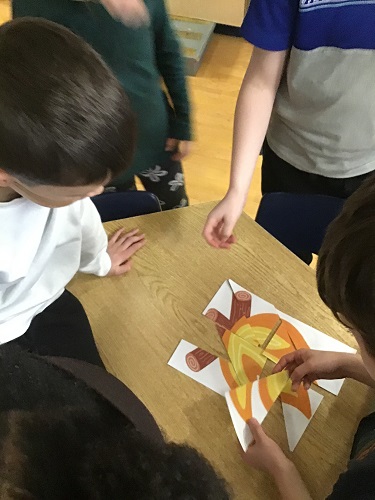 Inside the tent they discovered a map, which guided them to another puzzle. Once completed, the puzzle directed them to a book containing a matching activity and a set of math questions to solve.
Working collaboratively, the children shared ideas, solved problems, and supported one another as they moved through each clue. Their final challenge was another locked box containing a note inviting them to celebrate their success by roasting marshmallows over the campfire.
This activity encouraged teamwork, critical thinking, literacy, and numeracy skills, while giving the children an exciting and playful way to conclude their camping exploration together.
Possible Next Steps
- Explore map reading and create simple treasure maps for outdoor scavenger hunts.
- Invite a member of Girl Guides of Canada or another community member with camping experience to share outdoor skills with the children.
- Learn about local wildlife and plants that can be found while camping in Ontario.
Through teamwork, creativity, and curiosity, the children transformed a simple forest walk into a rich exploration of building, camping, science, and community learning.