During the month of April, School Age 1 educators have observed the children’s growing interest in cars, and creating tracks and roads to drive the cars on.
As the children in School Age 1 have developed an ongoing interest in cars, they compared cars and noticed the different colours, sizes and speeds. The children’s interest blossomed as they pushed cars across the floor, table, carpet, blocks and various tracks that they have made. The children discussed whe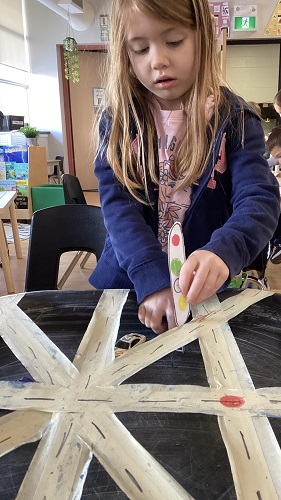 re the cars could be going as they imagined roads and pretended to drive down busy streets.
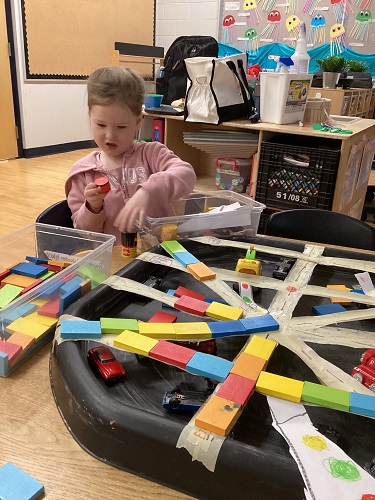 One morning, as a group we decided that we should work together to create a proper road for the cars to drive. Together, we began building roads using a tuff tray and tape, taping long strips across the tuff tray in lots of different directions. We added dotted lines across all the strips of tape and the children shared the space, pushing the cars in every direction. The children engaged in conversations about directions, traffic and where each car might be going. Chloe B. suggested that we add a red circle to look like a stop sign in the middle of the tape roads. Lucas M. said “we should even add traffic lights too!” The children heard Lucas’ idea and joined him. Using paper, popsicle sticks, tape, crayons and markers, the children sat together at the table to create their own unique traffic lights to add to our roads. Lucas M. added arms to his traffic light and said “it looks spooky and it will point where the cars should go.” Alessio made his traffic light big, while Aleah made hers small. The children used scissors to cut out their traffic lights. Chloe B. folded the end of her piece of paper and taped it down on the tuff tray and Aleah taped hers to a popsicle stick, leaning it in between the rows of tape roads. It was wonderful to observe the children as they came together, and it was interesting to see the children’s individual thought processes as they were all different from one another.
Later, Oakley added blocks on top of the tape roads for the cars to drive on top of. She noted that it was smoother to push the cars over the tape than the blocks, because the blocks separated and created tiny bumps in the road. Lucas M. and Calen decided we should add more alongside the roads. The children used paper and scissors again, this time to create hospitals, malls, grocery stores and houses.
Soon after, the children decided we needed a place for the cars to park, so we used a tuff tray and recycled cups to create a parking garage for the cars. We added swirly lines with chalk and the children traced the routes with their cars. After creating a road and a parking garage, the children worked together to create a long bridge using tape and popsicle sticks. The children took turns pushing their cars across the bridge, and Zyaire experimented with putting a big car and a small car on the bridge at the same time. Laura noticed that the small cars go further than the big cars and said “the small cars almost fall off at the end because they’re so fast!”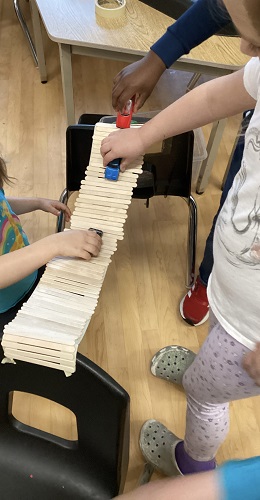
Our exploratio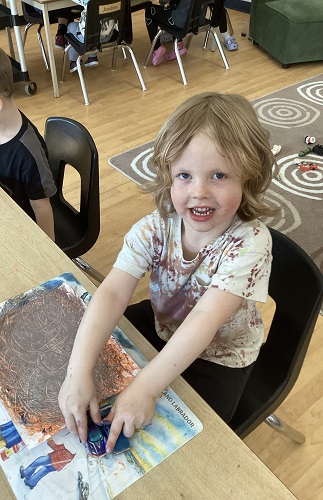 n continued with car painting. At the table, children dipped toy cars into different paint colours and rolled them across a piece of paper, watching the car tracks appear. Felix noticed as the blue began mixing with the orange, creating a new, unique colour. Finn noticed that the bigger cars left a different pattern in their tracks than the small cars. The children experimented with different ways to create tire marks in the paint and shared their ideas with each other. The children proudly displayed their creations with their peers and families. Car painting allowed the children to explore art in an open-ended way and provided an opportunity to combine sensory play with creativity.
Through these experiences, the children have participated in lots of collaboration, turn-taking and teamwork. They practiced their communication skills by expressing their ideas and listening to others. Working together to design roads and bridges also connects to the children’s cognitive development as thy explored multiple possibilities and tested different ideas. Through building, painting, cutting with scissors and manipulating small objects the children strengthened their fine motor skills.
To continue the children’s learning based on their interest in cars, we plan to build ramps for the cars next. We plan to do this by using various materials such as cardboard, tape and popsicle sticks. As a group, we want to make predications and compare the ramps and the speed of the cars. We can do this by creating different ramps and making comparisons based on the length and height of each ramp, as we explore measurement and force by experimenting with different angles and surfaces. We can encourage the children to create maps, communities and cities and incorporate literacy by creating labels using words such as ‘park’, ‘stop’, ‘go’, as well as street signs. By engaging in interest-driven play, the children are not only engaged but also eager to learn, as these experiences create meaningful opportunities that feel exciting for them. We are excited to see where the children’s interest in cars takes us next!