The toddlers have been demonstrating a strong and ongoing interest in farm animals. This experience was intentionally planned as a follow-up to their repeated engagement with animal toys and their joyful singing of “Old MacDonald Had a Farm.”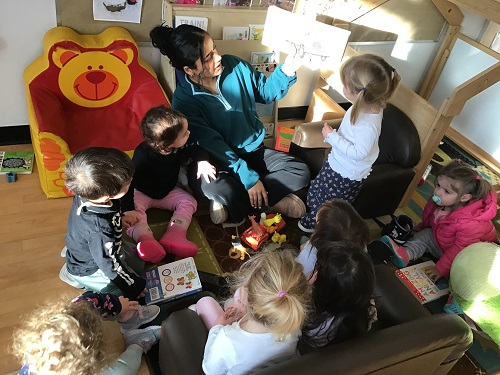 During group times, the children eagerly named animals, made animal sounds, and requested the song multiple times, showing clear interest and curiosity about farm life.
 To extend the children’s interest in farm animals, various provocations were thoughtfully prepared to deepen their exploration. A sensory bin filled with shredded paper as “hay” and pieces of green grass invited children to feed the animals. A barn house, tractor, and farm animals such as a pig, hen, cow, dog, elephant, sheep, and alpacas were added to enrich the play experience. Nearby, another bin containing tiny rocks and water allowed children to provide water for the animals.
The children eagerly engaged with the setup. They juggled the animals, tossed the shredded paper into the air, and demonstrated how their animals were eating. Some carefully walked the animals along the edges and jumped them across the circular wooden path bordering the sensory area. Throughout the experience, children practiced turn-taking, negotiated space with peers, and proudly shared their imaginative ideas. Their creative thinking and developing social skills were evident as they collaborated and built stories together.
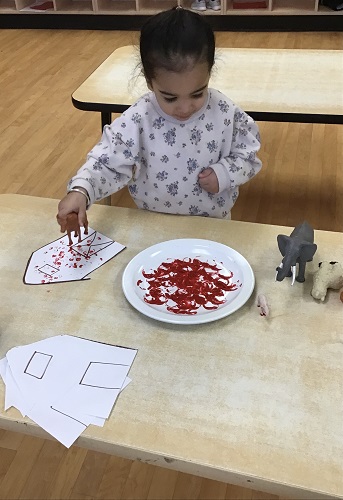
The exploration continued through a painting provocation. Red and black paint, along with a barn-shaped paper cutout, were introduced. Children selected their preferred animals, dipped their feet into paint, and observed the different footprints created on the barn paper. They explored cause and effect by noticing color differences and varying print shapes. Some children carefully controlled the amount of paint and gently pressed the animals onto the paper, observing peers who demonstrated precision and control. Others expressed themselves more freely, creating joyful “paint dances” with bold movements. This collaborative experience fostered observation, cooperation, and expressive creativity.
To further extend the children’s ongoing interest, educators introduced oobleck as a sensory provocation, inviting toddlers to explore texture, movement, and imaginative play simultaneously. For many children, this was their first experience with oobleck, and they approached it with curiosity and excitement. Children initially engaged by touching, squeezing, and observing how the material moved around the farm animals. Some toddlers showed mixed reactions to the unfamiliar texture, quickly pulling their hands away and seeking to clean them; however, this did not limit their participation. Instead, they remained engaged as observers, closely watching peers interact with the mate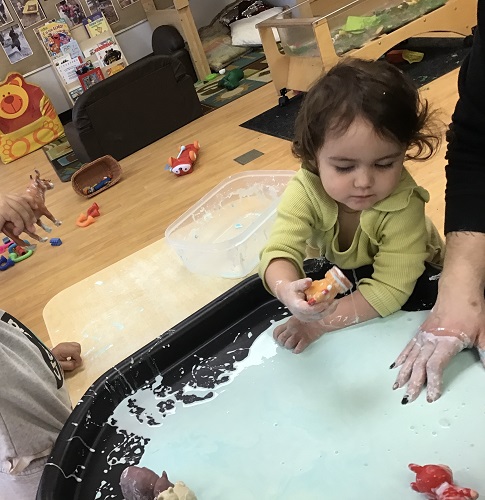 rial. Over time, children revisited the experience at their own pace, demonstrating growing confidence, social learning, and sensory awareness as they transitioned between observing and active exploration.
To extend the theme even further, brown playdough was introduced as “mud” on the sensory floor. Children explored animals walking through the mud, noticing different shapes and sizes of footprints. They later washed the “dirty” animals with water, scrubbing the mud from their bodies. This experience supported fine motor development, problem-solving, and nurturing behaviors.
Language and literacy were intentionally supported throughout the experience. Educators read various farm-themed stories, with Little Blue Truck being a particular favourite. The toddlers eagerly connected the story to their play. Since a blue truck was unavailable, children creatively substituted a yellow dump truck and a red truck to represent the character. Other children gathered the animals they recognized from the book illustrations, demonstrating symbolic thinking and early comprehension skills.
During another hands-on learning experience, gloves filled with water were attached to a picture of a cow. Children attempted to squeeze the water out through tiny holes, referring to the activity as “milking the cow.” This experience strengthened th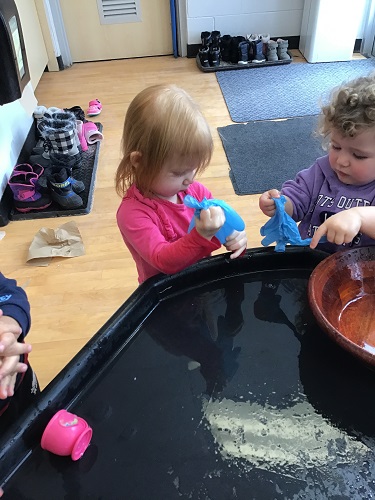 eir understanding of farm-related concepts while encouraging curiosity and exploration. Vocabulary such as udder, squeeze, and milking emerged naturally during play, supporting language development and conceptual understanding.
Physical development was also incorporated through animal freeze dance and pretend play walks around the room. Children moved like cows, hopped like sheep, and stomped like elephants, strengthening gross motor skills while engaging in imaginative expression.
This experience highlights how powerful it is to follow children’s interests. By extending their fascination with animals and songs, we supported holistic development across multiple domains — social, emotional, cognitive, language, and physical. The children showed emerging empathy while caring for animals, strengthened fine and gross motor skills, practiced turn-taking, and developed early literacy connections. Their ability to make symbolic substitutions (e.g., using a different colored truck) reflects growing cognitive flexibility and creativity.
To further extend this interest, we can:
- Introduce real-life farm images and explore where different animals live.
- Invite sensory experiences with natural materials such as straw, soil, or seeds.
- Create a simple farm dramatic play corner with dress-up props.
- Explore animal families (baby animals and their names).
By continuing to build on their curiosity, we will nurture their growing sense of wonder and inquiry about the world around them.