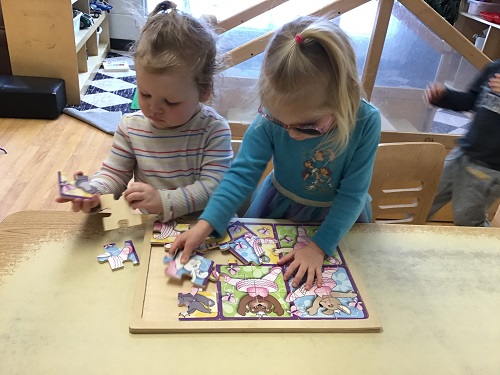
 Over the past few weeks, our preschoolers have shown a strong and ongoing interest in puzzles. Each day, a variety of puzzles are thoughtfully set up on the tables to invite exploration and engagement. The children consistently gather around with curiosity and enthusiasm, eager to challenge themselves and work together.
Many of the puzzles presented opportunities for persistence and problem solving. Kobe, Owen, Jibreel, and Penny carefully examined the pieces, moving them back and forth, turning them left and right with focus and determination. They demonstrated patience and resilience, refusing to give up until each piece fit correctly. Their excitement was evident as they clapped their hands, cheered, and proudly exclaimed, “We did it!” after completing the puzzles.
As puzzle exploration continued, children began making meaningful connections with the images. Oscar explored several puzzles and confidently named what he recognized, such as garbage trucks, bikes, cars, and a seesaw at the park. Lily joined in by selecting a sheep puzzle piece. When asked what sound the animal makes, she happily responded, “Ba Ba,” demonstrating emerging language skills and confidence in communication.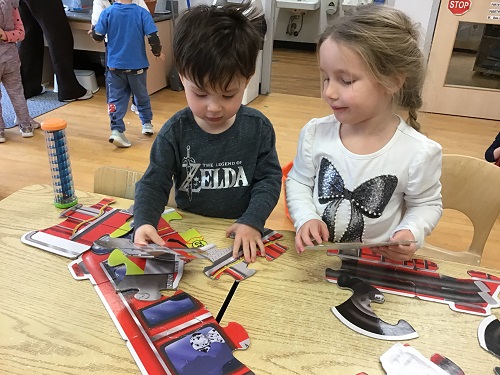
Expanding on their learning journey, the preschoolers participated in a creative puzzle-making activity where they designed their own heart-shaped puzzles. Together, they cut large hearts from paper and explored how to divide them into two and four pieces to create simple puzzles. The children then decorated their pieces using coloured tissue paper, buttons, and stickers, adding creativity and personal expression to the experience.
Building further on their interest, educators introduced magnetic tile puzzles using photographs of the children’s own bodies. The classroom filled with laughter and excitement as children carefully rotated pieces, compared colours, and identified familiar features. Lyle excitedly shouted, “That’s my pants!” while Owen pointed and said, “This is my Halloween costume in the picture.” Cole added, “That’s my yellow shirt!” These moments supported self-recognition, identity, and a strong sense of belonging.
Each puzzle became a joyful challenge, transforming play into moments of discovery, pride, and accomplishment as their pictures slowly came together. To extend the learning, number and picture puzzles were added to the environment. These quickly became favourites, with children regularly choosing them during free play, counting items in the pictures and matching them to the correct numbers. Popsicle stick puzzles featuring moons and stars were also introduced, encouraging cooperative play and problem-solving in new ways.
Another highly popular activity was the fire truck puzzle. As the children explored it, they enthusiastically sang “Fire truck, fire truck” together, eagerly searching for and holding the hose puzzle piece. During one exploration, Penny pointed to a puppy image and said thoughtfully, “The puppy is sad because his family is stuck inside the house,” showing empathy and storytelling skills emerging through play.
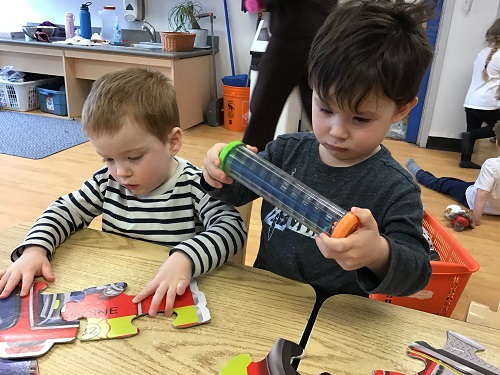 Behind the fun, meaningful learning continues to take place. Puzzle experiences support the development of logical thinking, problem-solving skills, spatial awareness, memory, focus, perseverance, and fine motor coordination. Using personal photographs further strengthens children’s self-identity and confidence, making learning deeply meaningful and motivating. These collaborative puzzle experiences also encourage language development, communication, and positive social interactions as children work together, share ideas, and celebrate success.