While playing “school,” children Layla, Aria, Paisley, and Emma engaged in imaginative role play when Emma pretended to be sleeping. When asked what she was doing, Emma responded, “I have ADHD.” This prompted a group discussion about what ADHD means.
When asked what it means to have ADHD, One of the children shared, “It means you have no brain.” This honest response created an opportunity for learning. The educator explained that ADHD means the brain works a little differently and that it can sometimes make problem-solving, decision-making, and impulse control more challenging. The educator emphasized that everyone has a working brain—brains just work in different ways.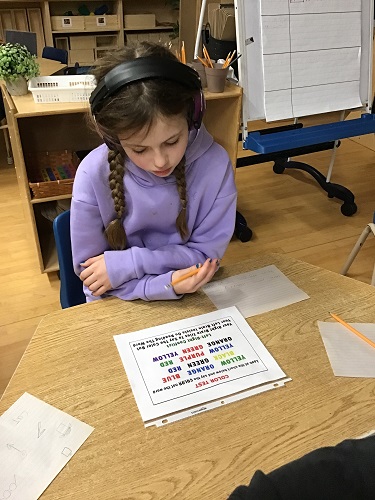
This conversation sparked strong interest among the children, and several began sharing personal connections:
- Devyn shared, “My sister tells me I have ADHD because I am always so hyper.”
- Almalinda explained, “I have ADHD and take medication to help me focus in school.”
- Elora shared thoughtfully, “I have ADHD and Autism. I take medication and go to therapy. I try really hard, but sometimes it’s challenging for me to participate. That’s why I wear my headphones.”
The children engaged deeply, listening intently and responding with curiosity. One child remarked, “Wow, I didn’t know so many people have ADHD.”
Building on this interest, the group explored how the brain works and how different parts of the brain have different jobs. The educator introduced the Frontal lobe in charge of thinking, speaking, movement, problem-solving, and impulse control, the Temporal lobe responsible for emotions, learning, and hearing. The Parietal lobe for language, the Occipital lobe which related to vision and colour perception and finally, the Cerebellum and brain stem responsible for balance and basic body functions
 The children discussed how ADHD can impact some of these areas, particularly impulse control and emotional regulation.
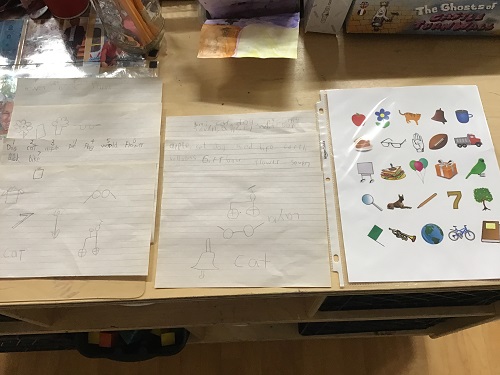
To extend learning, the children participated in several brain-based activities: Short-term memory challenge where children viewed a page with over 20 images for 30 seconds, then attempted to recall and write as many items as possible. They compared results and reflected on memory differences. Bilateral hand movements and drawing had the children practicing using both hands at the same time while completing different movements, supporting coordination and brain-body connections. The children also participated in a dominant hand challenge, the children had 30 seconds to color in circles using their right hand and then switched to their left. The group reflected on which hand felt easier and discussed how the opposite side of the brain controls each hand.
Elora shared prior knowledge during this discussion, explaining, “The right side of your brain controls the left side of your body, and the left side controls the right side. That’s why when someone has a stroke on one side of their brain, the other side of their body is affected.”
As conversations continued, the group explored impulse control, discussing how sometimes our brains tell us to act before thinking. To support understanding, the children played games such as Freeze Dance, Simon Says, and Red Light–Green Light, practicing self-regulation in playful ways.
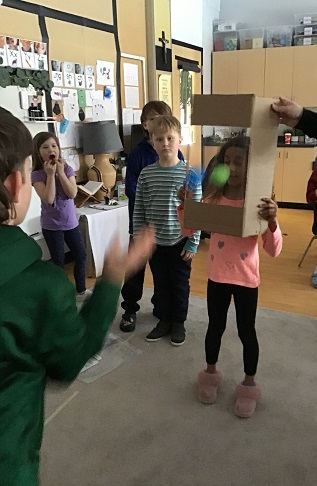
The children also explored reflexes. During discussions, the educator gently tested reflex responses by calling children’s names and tossing a soft ball. Later, children participated in a reflex activity using a transparent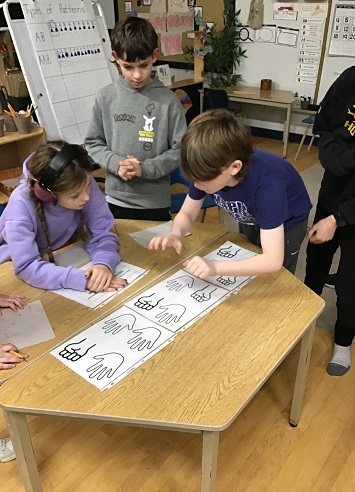 shield, attempting not to blink as a ball was gently tossed.
Riggins shared his experience: “I tried to hold my eyes open really wide, but I couldn’t help it.”
Elora responded, “It’s a reflex—you can’t control it. Blinking just happens when your eyes feel scared.”
Children also viewed brain images comparing ADHD and neurotypical brains, further reinforcing the idea that brains can look and work differently, and that differences are a natural part of being human.
 This emergent conversation around ADHD and how the brain works demonstrated the children’s capacity for empathy, scientific thinking, and respectful dialogue about neurodiversity. What began as dramatic play evolved into meaningful discussions where children shared personal experiences, corrected misconceptions, and built a shared understanding that everyone’s brain works differently.
Through hands-on activities exploring memory, bilateral coordination, reflexes, impulse control, and brain function, the children actively engaged in inquiry, experimentation, and reflection. Their thoughtful questions, sustained engagement, and ability to make real-world connections showed a growing awareness of themselves and others, as well as an appreciation for differences as strengths rather than limitations.
To further this learning, educators reflected on ways to continue deepening the children’s understanding of neurodiversity in inclusive and empowering ways that promote empathy and self-advocacy. This learning will remain a focus in our everyday interactions, as we intentionally create space to openly discuss our differences and celebrate how they make each of us unique.