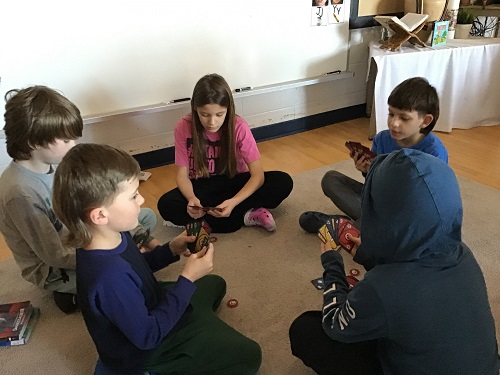
 School Age 2 children have shown a sustained and growing interest in games, probability, and strategy. Building on their interest from last month, the children were excited to receive new games at Christmas. One of the most popular was Castle Turnwall, a magnetic, rotating castle board game that uses three actions—move, slide, and rotate—to find costume pieces. The goal is to collect four unique costumes to complete an outfit. As they played, the children demonstrated turn-taking, planning, prediction, and flexible thinking. They also continued to enjoy familiar card games such as Skip-Bo and Uno. Several children brough
 t in different versions of Uno from home to share, encouraging peer teaching and collaboration as they compared rules and variations of the game.
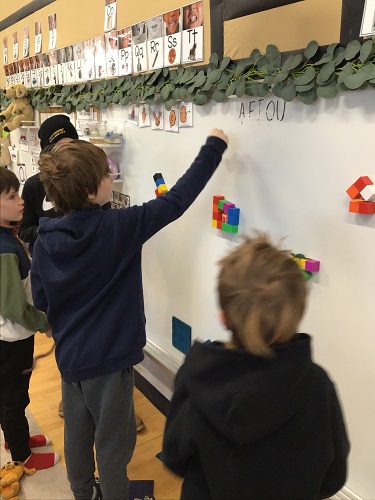
One morning, educators observed the children transferring their interest in games into their own self-created challenge using magnetic tiles and blocks. The children-built animal shelters of different shapes and sizes on the whiteboard, aiming to create the strongest structure possible. Their goal was to test how many pieces it would take to “break the animal free.” They began experimenting by dropping magnetic triangles from above, the size after each increment of five. When the smaller magnetic tiles didn’t work, they moved to the largest square.
“I can’t believe we’ve done all the pieces and none broke through—hopefully this big one does. Are you ready, guys?” Finley said. When the structure finally collapsed, the room filled with cheers and laughter. “Let’s see if we can make the next one even stronger,” Riggins added.
Through this activity, the children engaged in prediction, problem-solving, early engineering, and scientific inquiry. They reflected on which designs were sturdier and immediately challenged themselves to improve their structures. This game has continued to evolve and remains a favourite among the group.
Inspired by the children’s creativity, educators introduced new materials including a corkboard, push pins, rubber bands, and marbles. The children worked together to design and test a marble maze. They discussed where the push pins should go, how to stretch the rubber bands, and problem-solved when the marble did not move as planned. The children showed persistence and teamwork, refusing to give up until the marble successfully rolled through the maze. Each day, they returned to redesign and create a new version, applying what they learned from previous attempts.
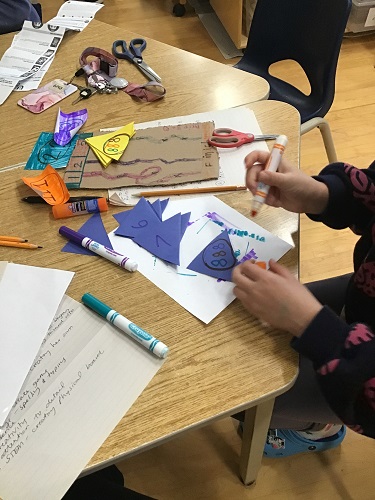
Seeing the children’s strong interest in both playing and inventing games, educators introduced a long-term project: Build Your Own Game. The children were encouraged to think about what type of game they wanted to create—board, card, or dice—and what materials they would need. They began by sketching their ideas, then writing the object and rules of their game.
 “I want to create a board game,” Brielle said. “I want to make a game too!” Emma shouted.
Educators supported the children step-by-step, guiding them through decision-making and planning. “First, you need to decide what kind of game you’re making,” the educator explained. Brielle decided, “I want it to have three different trails that everyone has to race down to the end.” She created a three-player board game, each with a different challenge. Players move using triangle cards, encountering obstacles such as missing a turn, switching places, or choosing another player to miss a turn.
Emma created a dice-and-cup game where the goal is to reach 20 points first. Players shake a die in a cup and follow number-based instructions that include adding, subtracting, and missing turns, making the game more challenging and strategic. Caden and Spencer are currently designing their own card game, sharing ideas and negotiating rules as they go.
Throughout this experience, the children demonstrated creativity, collaboration, numeracy, literacy, and confidence. They planned, tested, revised, and proudly shared their ideas with peers. To honour their hard work and extend learning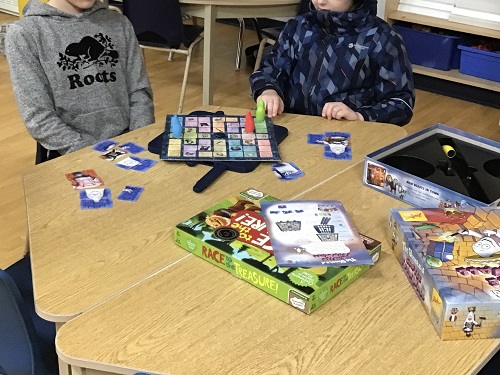 beyond the classroom, educators have invited families to a game night, where children will teach their parents how to play the games they created as well as some of our classroom favourites. This experience supports communication skills, strengthens home–school connections, and celebrates the children as capable, creative learners.