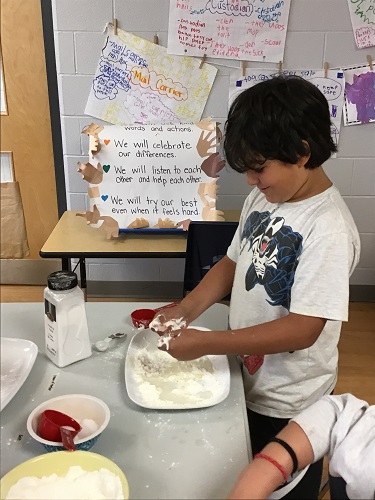
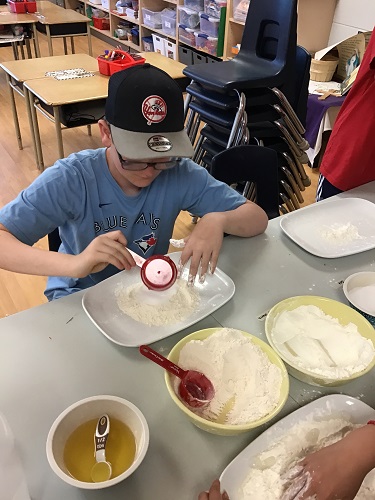
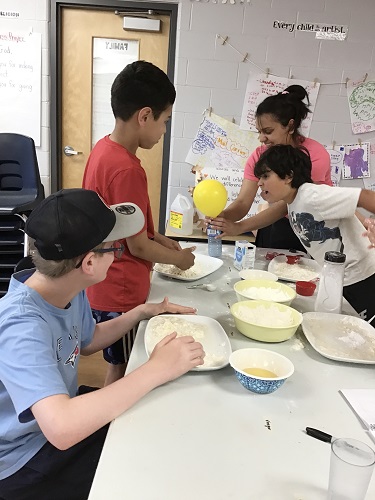
Today, the children were invited to freely explore a variety of kitchen ingredients set up at a sensory science station. With no specific instructions, they mixed, poured, stirred, and experimented with different combinations. The children shared their observations with peers, asked questions, and made predictions about what might happen with each new mixture. Sofia experimented with different dry and wet ingredients and, through trial and error, created a dough-like substance. She proudly announced, “I made play dough!” and adjusted her mixture to improve its texture. Her experimentation demonstrated persistence, creative thinking, and an intuitive sense of balance in combining ingredients. Leo focused on mixing baking soda and vinegar. His excitement grew as he created a fizzing reaction, exclaiming, “It’s like a volcano!” Leo then added more ingredients to observe how they changed the effect, showing curiosity and cause-and-effect thinking. In between the exploration, we figured that if we put vinegar in a bottle and baking soda in a balloon and put the balloon on the mouth of the bottle in a way that baking soda falls in the vinegar, they react together to produce Carbon Dioxide which inflated the balloon. Later, it turned into a sensory sound activity as Leo moved the solution around in the balloon and into the bottle which made popping bubble sounds which was very satisfying to hear. Iggy explored the combination of cornstarch and water. After some mixing, he discovered the unique texture of oobleck—solid when pressed, liquid when relaxed. He repeatedly squeezed and released it, fascinated by its changing form, engaging in tactile sensory learning and scientific observation. Joey took a more exploratory approach, mixing a variety of ingredients together without a specific goal. His experimentation was rich with sensory engagement as he observed changes in texture, smell, and colour, expressing delight in the process itself rather than a final product. Allowing children to explore freely with science supplies fosters curiosity, creativity, and a deep love for learning by encouraging them to ask questions, experiment, and discover on their own. This hands-on, open-ended approach develops critical thinking and problem-solving skills while building confidence and resilience through trial and error. It also promotes collaboration, communication, and practical understanding of scientific concepts in real-world contexts. By engaging in unstructured exploration, children not only strengthen fine motor skills and independence but also learn that science is a dynamic and accessible part of everyday life.