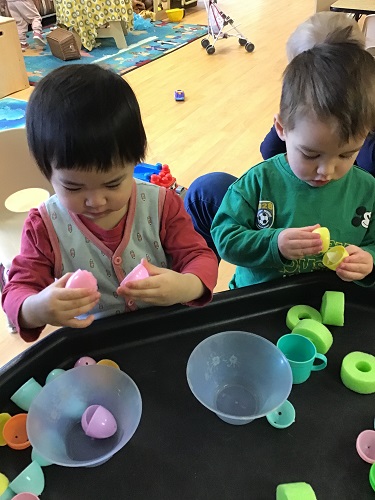
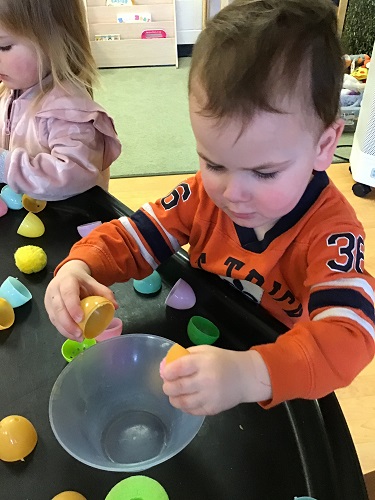
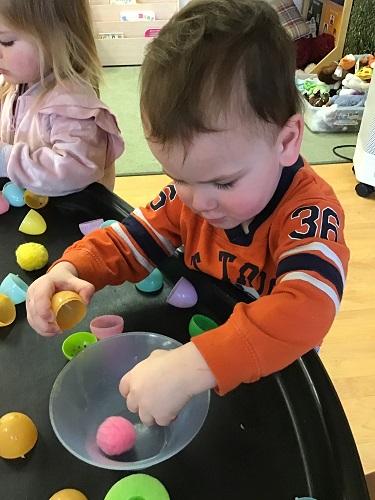
Toddlers learn best through playful, hands-on experiences, and even simple activities can become powerful opportunities for daily learning. One engaging idea we explored with Easter eggs involved placing soft, fluffy balls inside empty eggshells and inviting toddlers to crack them open.
Educator Simmy began by demonstrating how to crack an egg using a bowl. She gently tapped the egg on the edge, then used her fingers to apply a small squeeze at the center. When the toddlers saw a colorful, fluffy ball “pour” out of the egg, they were delighted. “Oh, there is the egg yolk! Do you remember how mommy and daddy cook eggs in a pan?” Simmy asked, encouraging them to connect the activity to their own experiences.
Declan listened attentively and eagerly followed each step. With minimal assistance, he selected an egg in his favorite color, tapped it, squeezed, and opened it. The other children watched closely and soon began to imitate the process of tapping, squeezing, and exploring with curiosity. “Look! My egg yolk!” Noah exclaimed joyfully. “Mommy and daddy cook eggs,” Nathan added. “Do you have eggs for breakfast, Nathan?” Simmy asked. “Yes!” he nodded.
This activity supported the development of fine motor skills as the toddlers used their hands and fingers to manipulate the eggs. It also strengthened memory and sequencing as they began to recall the steps: pick up the egg, tap or press, open it, and discover what’s inside. Through repetition and exploration, our toddlers developed confidence, coordination, and early problem-solving skills.
Observing moments like these inspires educators. While such activities may seem small, they highlight the importance of being intentional and creative in facilitating toddlers’ learning. Through everyday experiences, children begin to discover and make sense of their world while building meaningful relationships and necessary learning skills.