A few days into the month of April, Harper, Brielle, Korah, and Eve engaged Educator Vanessa in a conversation about coffee and Starbucks, which led to them making her a Starbucks coffee of her choice out of natural loose parts found outside. This prompted Vanessa to try and think of a way to bring this idea into the program room. After some deep reflection and brainstorming, she came up with the idea of using black sensory beads as coffee beans, cotton balls to be used as whipped cream/marshmallows/milk or creamer, and stir sticks for mixing. For cups, Vanessa brought in some authentic Starbucks red cups, plus some disposable paper and plastic cups. We ended up decorating these disposable cups by taping a label on them so that they represented Starbucks cups.
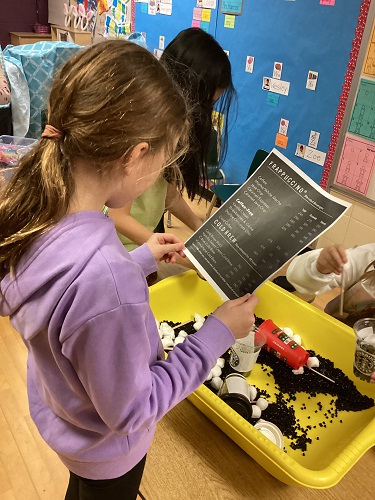
The first day, Vanessa explained to the group of girls who she had initially had the coffee conversation with that she had a coffee sensory bin idea- this excited them. Korah said, “I want to be the boss!” Brielle wondered what kind of drinks she would make. Vanessa wondered if we should make a menu, but after some confusion from some of the other children about what exactly to order at Starbucks, we looked up a few old menu templates online and printed them for the table as a starting point. Avery wondered, “what’s the difference between a tall, grande, and venti?” Brielle helped identify the sizes as small, medium, and large. Maria wondered, “how do we make some of these drinks?” Vanessa explained that a lot of Starbucks drinks are espresso based and have milk added in along with flavour shots. When Maria went to make drinks, she used the cotton balls to add images on top like a smiley face and a heart, knowing that some lattes have fancy designs on them.
Once the idea of making the drinks was established, it was time for customers. The barista would sit behind the table with the materials in front of them and wait for a customer to come. After being given an order, they’d proceed to make the coffee and hand them out. This became fairly repetitive, so Leila and Avery decided to change things up a little bit. “Let’s have our coffee delivered to our work desk,” Avery said. “Yeah, I’ll make a computer.” Leila agreed. They made computers out of paper and sat at the table, calling to their peers to deliver their drink order to their work station.
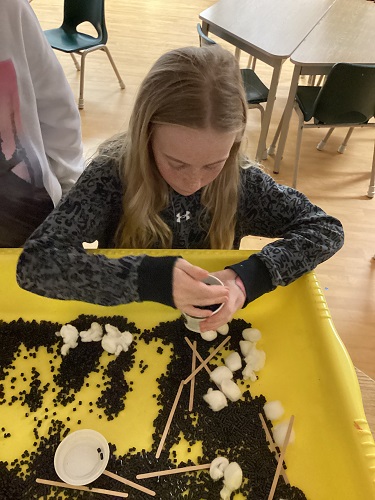
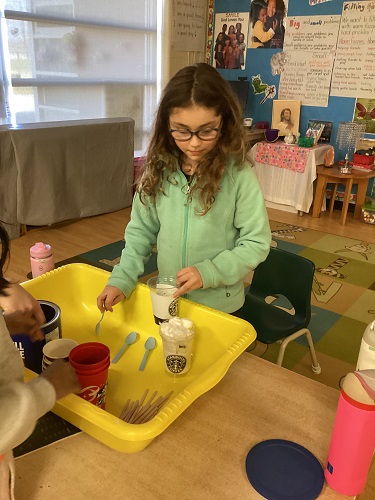
The children appeared to enjoy this experience, so we expanded on it by bringing in an actual empty coffee canister. Inside the canister was a bit of old coffee grinds; Vanessa transferred these grinds to a cup, taped the top, and then punched holes in it so we could add the aroma of coffee to our shop. The children also ended up transferring the black beads, which represented coffee, to the coffee canister so they could make it look like they were scooping real coffee. We also added plastic spoons to support the transfer effect. Harper took on the barista role with the canister, excitedly making coffees for all of her peers, and talking about the birthday Starbucks drink she’d recently gotten. Arianna ended up organizing the materials to make a more cohesive system, stacking the cups together, filling the coffee canister up, lining up the spoons and sticks for stirring, and pilling up the cotton balls so she could add them in drinks as needed. We discovered systems made the business more effective, but there was still one thing missing- the financial aspect.
To help the children learn about financial responsibilities, we brought in a money set so our business could be more substantial. Eve made a system up with the money- first, you gathered your money from the banker, then you gave your order to the cashier, and finally you approached the barista and awaited your drink to be made before paying for it. Leila drew a cash register to take orders, and created a wallet and money pouch from paper to hold the bills that were received. We established prices, with the cheapest drink costing $15! Therefore, we had to learn about budgets and affordability within the economy.
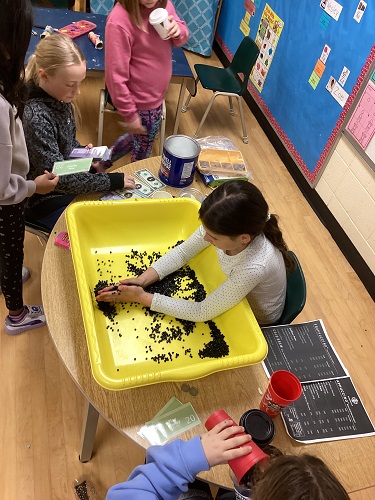
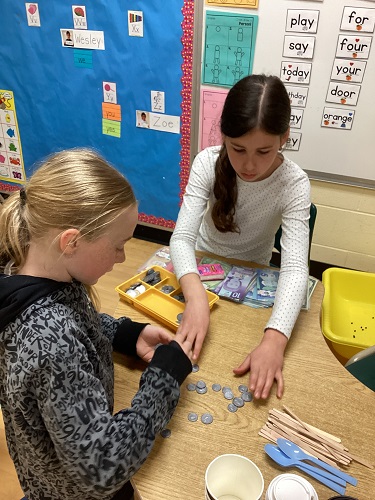
It’s amazing how a conversation about coffee can bloom into so much learning. We explored real life role play scenarios as we re-enacted what it’s like to order drinks at Starbucks. We also learned about a local business, and for some of our children, introduced them to the drinks and other merchandise sold there. We explored financial responsibilities and various mathematical concepts as we counted, organized, and explored money. We studied business and entrepreneurship as we started our very own Starbucks in our classroom, worked as a team, and engaged socially with each other. We got to be creative, too, as we made computers, wallets, and cash registers.