Preschool 2
Freezing Water and Food Colouring
December 2018
With our interest in block and animal play, combined with our ongoing weather project, the preschool two-room set about making coloured ice blocks to further our interests and learning. This diverse learning experience lasted a week.
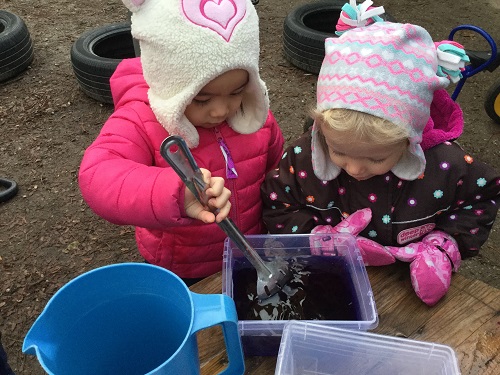
We took some ice cube trays and larger containers outside and poured water and food colouring into them. The children took turns stirring to mix it. While Alex was stirring Edith stood beside her and told her she was doing a, “great job mixing the colours,” and thanked her for giving her the spoon when it was her turn. Other children watched intently, each waiting patiently for their turn. They learned about colour mixing as they used the primary colours to mix purple, green, orange, and even brown. The children used their fine motor skills to hold the spoon. Stirring a spoon, having a child cross their bodies with their arms, also helps develop core gross motor muscles, and helps make connections crossing in their brains.
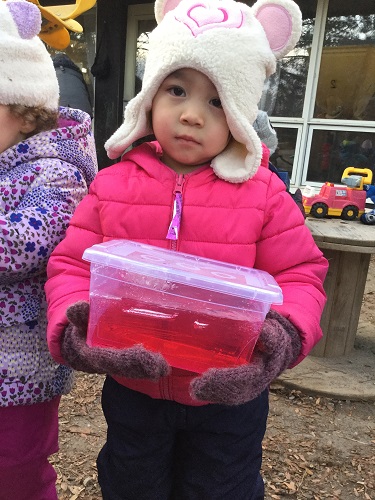
Once the containers were filled, we put them on our bench in our playground and covered them with a blanket to keep them safe. We then waited for them to become ice. This took much more time and effort than we thought. It was cold outside that night, but only -4c. The next morning when we looked, they were sadly still pure water. We noticed the sun shining on the bench during the morning and in the afternoon, when we checked again, we discovering still pure water. We decided to move the bench out of the sun. Bea suggested, “Maybe it just wasn’t cold enough yet.” The following night was colder, reaching -11c. When we checked the containers the next morning the ice cube trays were frozen, but the larger containers were only partly frozen. In the afternoon, Hanna noticed how even though it looked frozen there was still water inside when you tipped the bigger containers. The next day, after it had snowed overnight, we were really thinking they would be frozen and we could play with them in the snow. However, the largest ones were still not frozen on the inside. Now the educators wondered if there was something in the food colouring that delayed the freezing process. With the children and the educators just a little bit sad and let down, we wondered what to do next. Luka suggested, “We needed to put them in the freezer.” That is what we did! We took the larger containers that were not completely frozen and put them in the bottom of our freezer.
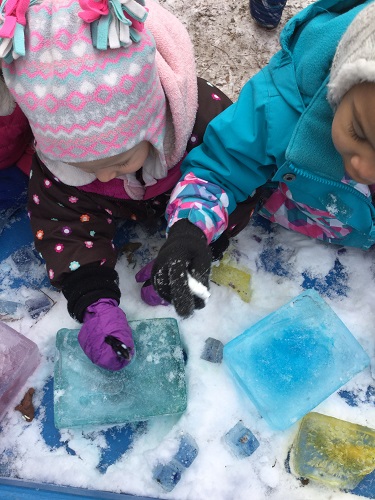
The next morning, they were finally frozen. We were all so excited to be able to play with our coloured ice. We noticed that even though we had mixed the water with the colours, the colour had concentrated in the middle of the ice leaving the perimeter clear. We set the ice blocks on our blue bench along with some small toy arctic animals. The children discussed that these animals lived in cold places, such as the Arctic; “Like where Santa lives,” said Mevaeh. Mevaeh first played with the white polar bear. Edith had the whale and began using its head to break tiny parts of a large block of ice where it was cracked. In the afternoon, the children kept asking if there was something inside the ice blocks. The educators reminded them that they didn’t put anything but the colouring inside the blocks, but some children insisted that it looked like something was inside because of the way the colour had frozen in the middle and in patterns. Mevaeh asked if she could break the ice. The educators asked how she thought they might set about doing that. Bea said, “We needed a tool” but was unable to name the tool we needed. Nathan began using one of the ice blocks to hit another ice block. He used all his might and finally broke his. The educators then got the children a hammer. Bea used her two hands to hit her blue ice block and broke it in half after a few hits. Then Skye set out the break the purple block. When it broke purple water poured out, spilled everywhere, and surprised all of us. “Guess it wasn’t quite frozen,” he said. Many other children took turns to use their gross motor skills and cross body movements to use the hammer and break the ice blocks.
It was a fun time of learning and experiences for all. The educators also acted as co learners when they finally looked at the ingredients on the food colouring label and found sodium benzoate, a type of salt. This was of course what caused the ice to take longer to freeze!