Board games can be lots of fun to play with a group of friends, filling time with excitement and laughter. Did you know that board games can also help foster a child's development? It helps to enhance a child's concentration, patience, memory, and logical thinking.
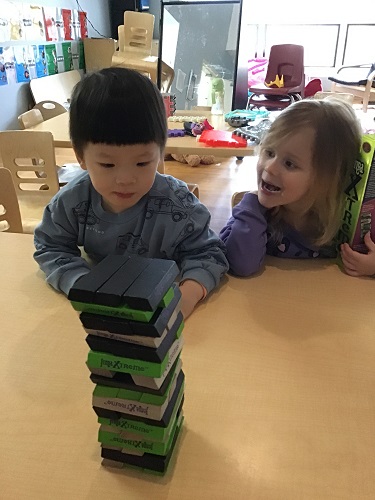
In the preschool one room we have been filling our days with the fun of board games. We started off with Jenga, creating the tower by balancing all the blocks, then using our fine motor skills and hand-eye coordination to pull out each block, stacking them on the top, being careful to not let the tower fall. Once it did fall Emmett and Cory were excited to rebuild the tower to play again!
Next it was a race against the clock as the preschoolers played perfection. The children were immediately drawn to the challenge of matching the different shapes into the correct spaces before the timer caused the board to pop. Throughout the experience, the children demonstrated patience, teamwork, problem-solving, and emotional awareness as they took turns and encouraged one another. As they waited for their turn, many children carefully observed their peers and predicted what might happen next. Austin counted how many pieces were left and excitedly chanted, “It’s gonna pop, it’s gonna pop!” as the timer neared the end. Evie anticipated the loud sound and covered her ears, showing awareness of her own sensory needs and preparing herself for the surprise. Jayden and Emmett worked together to help others find the correct matching shapes, demonstrating cooperation and kindness toward their peers. The children also explored early scientific thinking through experimentation and prediction. Jayden and Emmett wondered what would happen if they placed their stuffies on top of the game before it popped. First, they tested Emmett’s Baby Yoda stuffy, but it did not move when the timer went off. Then Jayden placed his piggy stuffy on top and counted down from five before the game popped again. When the piggy stayed in place, Jayden concluded, “It’s too heavy!” The children were developing critical thinking skills by making predictions, testing ideas, observing outcomes, and creating explanations based on what they experienced. We look forward to continuing to explore games that encourage collaboration, curiosity, and problem-solving in meaningful and playful ways.
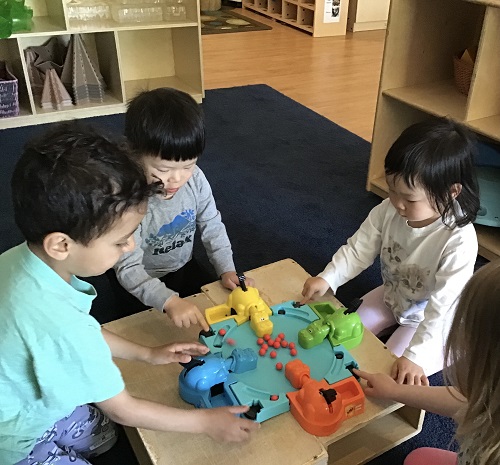
The children continued exploring their interest in board games through a fun and engaging game of Hungry Hungry Hippos. Many children excitedly recognized the game right away, sharing that they had played it before or even had it at home. This familiarity helped build confidence and encouraged meaningful conversations with peers and educators. As we played, the children practiced important social skills such as turn-taking, patience, and listening to instructions. Since only four children could play at a time, the children worked together to wait for their turn and respect the rules of the game. They also confidently expressed their preferences by choosing which coloured hippo they wanted to use, supporting their developing communication and decision-making skills. The game also provided opportunities for numeracy learning. After each round, the children counted how many balls their hippo collected and discussed which colours earned extra points. The yellow ball became especially exciting because it was worth more points, motivating the children to count carefully and compare results. Throughout the experience, the children demonstrated kindness and teamwork. Rory enthusiastically cheered, “You did it Jayden!” when Jayden collected the yellow ball, showing encouragement and positive peer relationships even when he had wanted the ball himself. We also discussed the importance of good sportsmanship and how games are meant to be fun, whether we win or lose. The children were highly engaged and eager to continue playing, asking for repeated rounds right up until it was time to head outside. Experiences like these help foster cooperation, early math skills, communication, and positive social interactions through play-based learning.
We also played some memory games, specifically a disney-pixar themed memory game. The children quickly became engaged and excited as they recognized many of the familiar characters on the cards.
Penny B quickly spotted characters from The Incredibles and proudly shared that she has them at home. Evie enjoyed finding the turtle from Finding Nemo and was eager to look for more familiar faces. Asal appeared very proud of herself each time she found a matching pair, beaming with a big smile and eagerly taking many turns throughout the game. Penny F shared that she had played this game before and demonstrated confidence as she participated. Memory games help children develop important cognitive skills such as concentration, visual memory, problem-solving, and turn-taking. They also encourage social interaction as children celebrate each other's successes and learn to play cooperatively. It was wonderful to see the children so engaged, recognizing familiar characters, and building their confidence as they searched for matches.
While board games can be a competition, it can also help children learn to take turns, help each other out, and socialize in a fun way. The children were able to develop in unique and creative ways, while also having fun, not only on their own, but also with others.