
Our toddlers showed great curiosity and enthusiasm as we introduced a variety of gross-motor invitations both indoors and outdoors. To support their developing physical strength, coordination, and spatial awareness, we offered playful activities such as aiming and throwing into a target, hopping over drawn lines, and walking along a taped pathway. These experiences encouraged children to test their abilities, practise body control, and explore how their movements can be intentional and purposeful.
1. Snowball Aiming Game – Outdoor Exploration
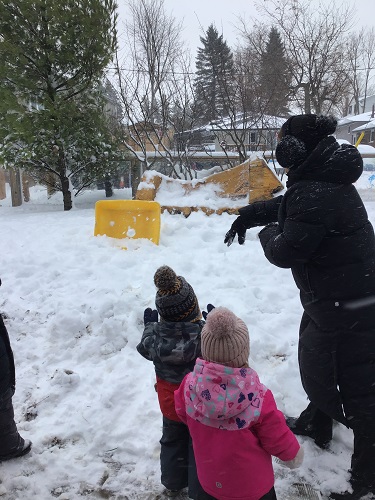 During outdoor play, a planned soft-ball activity naturally transformed into a spontaneous snowball-aiming game. The children excitedly requested snowballs, enjoying the sensory experience of packing, shaping, and crushing them. Seeing their interest, the educator placed a yellow basket at a distance to invite the children to aim and throw their snowballs into the target.
This simple extension sparked enthusiasm and focused engagement. Children experimented with different throwing techniques, adjusted their distance, and celebrated their attempts—whether successful or not. Otto and Hayden added a playful twist by standing near the post and turning the experience into a fun, cooperative group challenge filled with laughter, teamwork, and joyful discovery.
Skills Observed and Developed:
- Gross Motor Strength: Packing and throwing snowballs using upper-body muscles.
- Hand–Eye Coordination: Aiming at a target and adapting technique.
- Spatial Awareness: Understanding distance and direction.
- Social Interaction: Taking turns, cooperating, and engaging in shared play.
- Sensory Exploration: Feeling different textures, temperatures, and snow consistencies.
2. Hopping Pathways – Indoor Movement Play
Indoors, we created painter’s tape lines on the floor, inviting children to hop like bunnies while singing their favourite “Sleeping Bunnies” song. Children watched the educator’s demonstration—stretching their arms, bending their knees, and attempting their best hop. Some achieved full jumps while others took small steps, each engaging with confidence and determination.
Giggles filled the room as the children experimented with bigger and smaller hops, building control and rhythm. Later, the taped paths evolved into imaginative bike trails as children brought out their indoor bikes and designed their own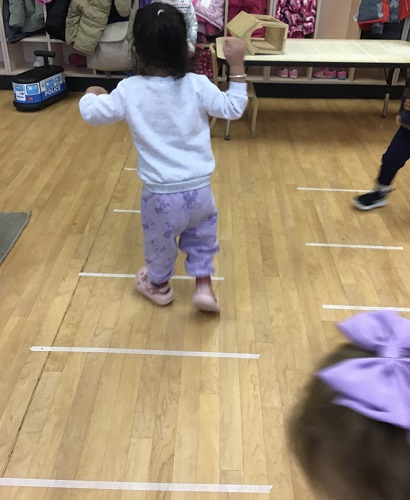 obstacle course, showing initiative and creativity.
Developing Skills:
- Gross Motor Strength: Building leg muscles through hopping and jumping.
- Balance & Coordination: Learning to move with control while following the path.
- Spatial Awareness: Navigating distance, direction, and shared space.
- Listening & Following Directions: Responding to simple cues linked to familiar songs.
- Creativity & Problem-Solving: Transforming taped lines into bike trails and co-creating challenges.
3. Balloon Exploration – Indoor Curiosity and Problem-Solving
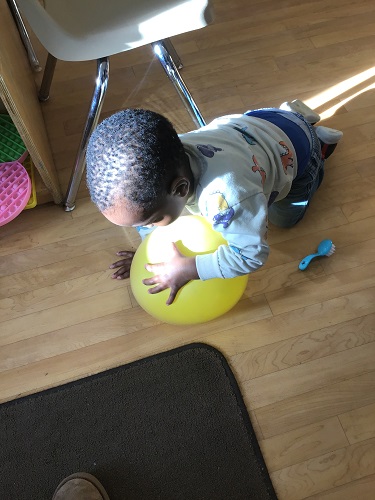
Another engaging invitation offered to the toddlers involved exploring balloons wrapped inside nylon fabric. This simple twist created a new sensory and motor challenge. The nylon covering made the balloon harder to grasp, inviting the children to test different hand movements and problem-solve how to hold and manipulate it.
At first, many children attempted to grab the balloon using their whole hand, but the smooth nylon caused it to slip away. With persistence and observation, they soon discovered a helpful strategy pinching the gathered end of the nylon. This allowed them to secure the balloon more easily and helped them feel in control of their movements. Their excitement grew as they mastered this new technique.
The nylon wrapping also changed the way the balloon moved. Unlike a regular balloon that drifts slowly, the nylon-covered balloon came down faster, encouraging the children to adjust their timing and movements. Children hopped up to try pushing the balloon toward the ceiling, then watched with anticipation as it quickly dropped back down. They used their arms, hands, and visual tracking skills to follow its fall and attempt to tap it again, strengthening hand–eye coordination with every attempt.
 Skills Observed and Developed:
- Fine & Gross Motor Coordination: Adjusting grasping techniques and using both hands and whole-body movement.
- Hand–Eye Coordination: Tracking the balloon’s movement and timing their pushes and catches.
- Problem-Solving: Discovering how to pinch the gathered nylon to hold the balloon securely.
- Cause & Effect Understanding: Noticing how the nylon covering made the balloon fall faster.
- Balance & Body Control: Hopping and reaching upward to keep the balloon moving.
- Sensory Exploration: Feeling the contrast between the soft balloon and the smooth nylon fabric.
To continue supporting the toddlers’ growing confidence, coordination, and problem-solving skills, we will build on their interests by offering new variations and challenges:
- Exploring Different Target Sizes: Introducing both smaller and larger targets outdoors to encourage children to adjust their throwing strength and accuracy.
- New Movement Pathways: Creating curved, zigzag, or intersecting chalk or tape lines to support more advanced hopping, jumping, and directional movement.
- Balance Challenges: Offering slightly narrower walking paths to promote core stability and mindful stepping.
- Balloon Extensions: Providing balloons with different fabrics or weights wrapped around them so children can compare how movement changes and continue experimenting with grasping techniques.
- Child-Designed Courses: Inviting children to help design their own obstacle paths, target placements, and balloon games, giving them ownership over the experience and deepening creativity and collaboration.
Through these upcoming invitations, we aim to extend their gross-motor development while encouraging curiosity, persistence, and joyful exploration.