
This month, the c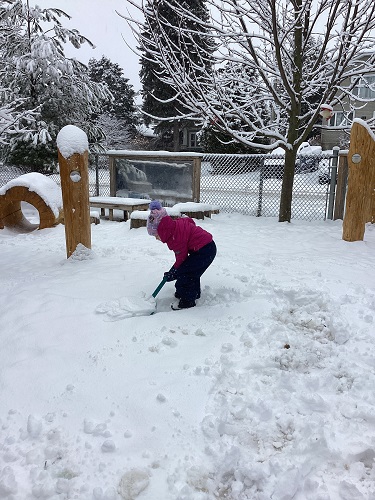 hildren in school age 1 have been very enthusiastic about snow. We have been exploring the winter weather in many different ways and participating in lots of different gross motor activities and sensory experiences.
The children have been enjoying shovelling snow in the playground before school, laying down and making snow angels, gently shaking the snow off of the trees, pushing and pulling each other on sleds and packing snow on top of various objects to bury them such as the tires and the stumps.
Chloe B. and Aleah worked hard, collecting handfuls of snow to cover a tire one morning, as they said that could be a good base for a snowman! While pulling each other on the sleds, the children have been practicing taking turns to be the one pulling a friend, and to be the one sitting in the sled. This supports the children’s gross motor skills as they push and pull the sleds around the playground, as well as their social and communication skills as they take turns and share with one another.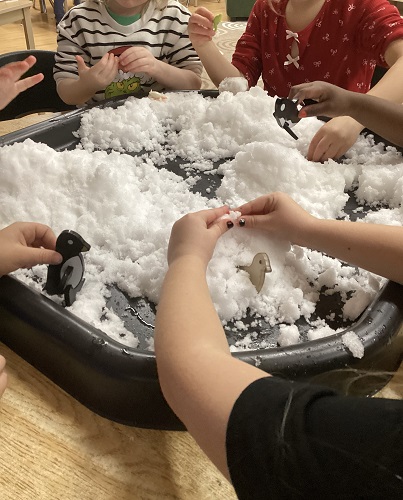
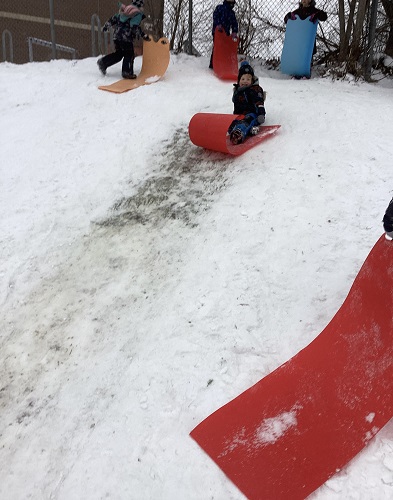
The children have been really enjoying the opportunity to use the sleds on the hill after school. They run up the hill to slide down as many times as they can. The children have been sharing the space on the hill and practicing safety as they are being aware of their surroundings and ensuring that they have enough space to safely sled down the hill. Paisley discovered that if she holds the handles on the front of the sled, she goes faster and stops further down to the bottom of the hill. Paisley made the observation that the hill near the soccer field is not as tall as the one by the baseball diamond so the children have more turns because it is faster to get back to the top of the smaller hill.
After sledding and shovelling, the children have been very curious about the texture and the temperature of the snow. To explore the sensory aspect of the snow and expand on the children’s questions and wonders, we filled a tuff tray with snow to bring in the classroom. As soon as he saw the tuff tray full of snow, Lucas M. wondered about what animals live in the snow and brought over our animal bin to see what animals we have in our classroom that live in cold and snowy conditions. The children took out a penguin, some whales, a seal, and a polar bear to hide them in the snow.
Chloe H. said there are different kinds of snow, and the children agreed that sometimes snow feels wet and sometimes it feels fluffy. Chloe B. said “when the snow is wet, that means it’s packing snow.” Paisley noted that the snow felt very heavy. The children engaged in a conversation about how the snow feels on their hands, how cold and wet it felt, and how easy it was to bury the animals in the snow. After burying the animals and digging them back up, Aleah said “there is still a whale in the snow but I can’t even find it now!” Paisley said “the snow is starting to melt in my hands now because I held it there for so long, and it’s making my hands cold.” Lucas M. said “the snow is making my hands so cold too, I need my mittens!”
 Overall, we have been having very meaningful conversations about the weather, and the temperature and texture of the snow. The children have been developing their gross motor skills by engaging in a variety of outdoor activities, and we have made some wonderful discoveries about the snow as well as the animals who live in it.
To continue to build on the children’s interest in the snow and winter weather, we will continue to bring snow into the classroom and experiment in different ways such as seeing if the snow will melt when we add water, adding small shovels and natural materials, and paint. We can also learn more about freezing temperatures by experimenting and leaving water outside, and tracking the weather. We can learn more about what animals live in the snow and also talk about animals that live in Canada and experience both warm and cold temperatures. We will continue to participate in gross motor activities outside by climbing, rolling and pushing the snow so that the children have the opportunity to create their own creative structures as well as things like snowballs, snowmen, and snowbanks.