
A new interest emerged in our classroom as the children explored cars, tracks, and magnetic tiles. When we introduced marbles to this play, the children became very engaged and began experimenting with different ways to use them. They built garages with magnetic tiles,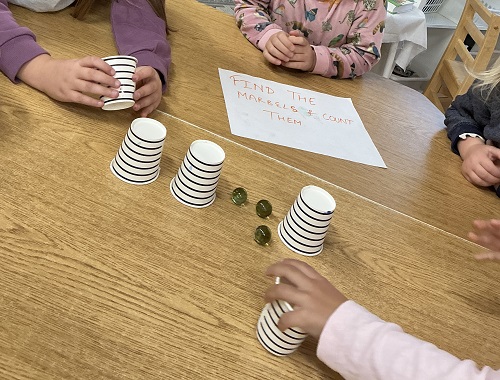 placed cars on one side and marbles on the other, and excitedly watched the marbles roll out whenever their structures fell apart.
To extend this interest, we introduced several activities that combined marbles with counting, guessing, painting, and fine-motor exploration.
First, we played a marble guessing game using four cups. We had two or three marbles under one of the cups and invited the children to close their eyes and guess which cup contained the marbles and how many were hidden inside. Everyone was eager to participate, calling out, “I want to guess!” We encouraged the children to take turns so that everyone had an opportunity to share their ideas.
 Next, we introduced marble painting. Since the children already enjoyed painting, we combined this interest with their curiosity about marbles. We placed paper inside a box, added drops of their favourite paint colours, and invited the children to add two or three marbles. As they moved the box in different directions, the marbles rolled through the paint, creating colourful and unique patterns. The children were excited to try their ideas and wanted to repeat the activity over the next two days.
We then introduced another challenge using a container covered with damp tissue paper. The children used pinchers to pick up marbles one by one, place them on the tissue, and count them as they went. They discovered that the tissue could hold only a certain number of marbles before breaking and allowing them to fall into the container below. This created excitement as they experimented with balancing the marbles and predicting when the tissue would break. Briar said, “It’s really cool! I want to count the marbles.” During the first attempt, Briar counted five marbles before the tissue broke. When we changed the tissue, it broke after only three marbles, giving the children another opportunity to observe, compare, and explore.
To continue extending this interest, we introduced a new circular strainer toy. The children placed marbles inside and rolled it, watching the marbles travel around and move down. They also continued exploring the 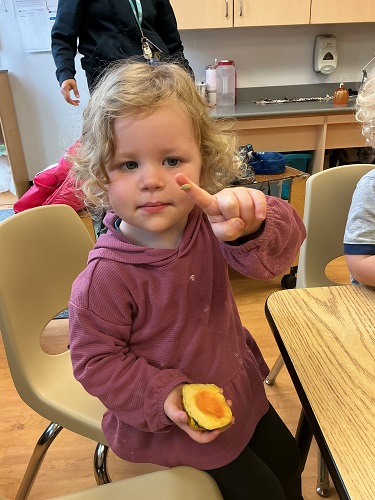 magnetic tiles, cars, and other materials, finding new ways to combine their ideas. Throughout these experiences, the children often requested specific quantities, saying things like, “I want five marbles!” and “I want ten marbles!” Their enthusiasm showed how much they enjoyed exploring numbers through play.
The children’s growing interest in marbles created meaningful opportunities for learning through play. As they counted, guessed, compared quantities, and predicted how many marbles the tissue could hold, they explored early mathematical concepts such as counting, number recognition, quantity, and cause and effect.
Building garages with magnetic tiles encouraged creativity, problem-solving, and experimentation. The children explored balance, movement, and gravity as they watched the marbles roll, fall, and move through different structures. Marble painting allowed them to investigate movement, colour mixing, and pattern-making while expressing their creativity.
Using pinchers to pick up the marbles supported fine-motor development, hand-eye coordination, and concentration. Taking turns during the guessing game also encouraged patience, communication, and cooperation. Briar’s excitement about counting the marbles demonstrated how a playful experience can encourage curiosity and a desire to explore mathematical concepts further.
We noticed how the children connected several of their existing interests, including cars, magnetic tiles, painting, and sorting, to create new possibilities for learning. By following their interests and introducing new materials, we were able to extend their play and encourage them to explore in introducing new materials, we were able to extend their play and encourage them to explore in different ways.
To continue supporting the children’s curiosity, we can introduce more open-ended activities that combine marbles with counting, building, art, and scientific exploration.
- By providing number of cups and invite the children to place the correct number of marbles in each cup.
- By introducing marble ramps made from cardboard tubes and different materials so children can investigate speed, distance, and movement.
- By offering a variety of materials for building marble garages, tunnels, and tracks, encouraging children to test and improve their designs.
- By extending marble painting by offering different paper sizes, colours, and box shapes so children can explore new patterns.
- By inviting children to predict how many marbles different materials can hold before they fall, comparing their predictions with the results.
- By encouraging children to share their observations and explain what they think will happen next.