
As the children reminisced about experiences from the previous year, one child asked if we could bring back the cork board, push pins, elastic bands, and marbles. This sparked excitement as the children began sharing memories of the marble tracks they had created and discussing what they might like to build again. By listening to the children's ideas and responding to their interests, we acknowledged their voices and demonstrated that their experiences and contributions are valued. Revisiting a familiar activity also allowed the children to build upon their previous knowledge while strengthening their connections with one another through shared memories and conversations.
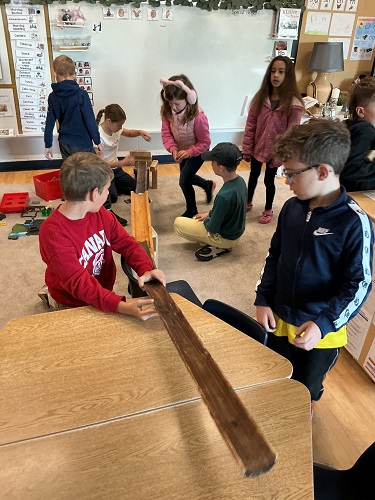 Since the children were eager to explore marbles and the educator was unable to leave the room to retrieve the cork board at that time, we offered ramps, half-pipes, chairs, blocks, and small cups. The children immediately began experimenting with different ways to balance and connect the materials to create their own marble runs. As they explored, they wondered whether they could make the marble jump from one ramp to another. By raising the end of one ramp above the next, the children tested their ideas and observed what happened. Through trial and error, they adjusted their structures, worked together to solve problems, and continued experimenting with ways to guide the marble into the cup on the floor. Each successful attempt was met with cheers and excitement, followed by conversations about what they wanted to try next. These moments demonstrated the children's growing confidence, persistence, and willingness to take risks in their learning. Rather than giving up when an attempt did not work, they continued exploring possibilities, developing their problem-solving skills and learning from one another.
The following day, the educators brought out the cork board, push pins, elastic bands, and marbles, allowing the children to revisit their original idea and create their own marble mazes. The children experimented with different shapes, patterns, and pathw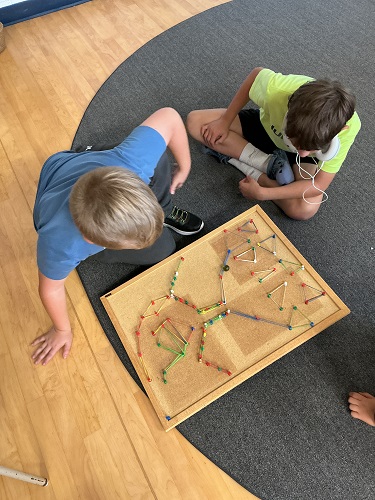 ays, carefully arranging the elastic bands to guide their marbles through the board. While some children focused on the cork board, others returned to the ramps and continued developing their marble runs. Having the freedom to choose how they participated allowed the children to follow their individual interests while remaining connected through a shared experience. Their sustained engagement showed how meaningful learning can develop when educators provide time, space, and materials that encourage children to explore their own ideas.
To extend this exploration, the children introduced small LEGO pieces as obstacles. They began building miniature villages and imagining stories around their creations. As the marbles travelled down the ramps, some children described them as snowballs or avalanches rushing toward the village, while others imagined a volcano destroying the structures below. The children transformed a simple marble run into an imaginative world, combining construction with storytelling and sharing their interpretations with their peers. Through this play, they expressed their ideas in creative ways while developing their ability to communicate, negotiate, and build upon one another's thinking.
The educators then introduced a box with multiple holes, inviting the children to experiment with getting their marbles through the openings. The children embraced the challenge and began releasing approximately ten marbles down the ramps at once rather than sending them down individually. This led to conversations about whether releasing more marbles would increase their chances of getting some through the holes. The children tested their ideas, observed the results, and considered what they might change during their next attempt. Mathematics and scientific inquiry emerged naturally as the children explored concepts such as probability, cause and effect, movement, and outcomes. By encouraging the children to investigate their own questions rather than providing immediate answers, we supported their curiosity, critical thinking, and active engagement in the learning process.
As the children's interest continued, the educators wondered what they might create if they were offered a new collection of materials. Boxes, popsicle sticks, glue, straws, lids, buttons, and other small loose parts were provided as an invitation to design their own miniature marble mazes. The children worked together to plan and construct their creations, making decisions about where to place materials and how to guide the marble from one end to the other. Once 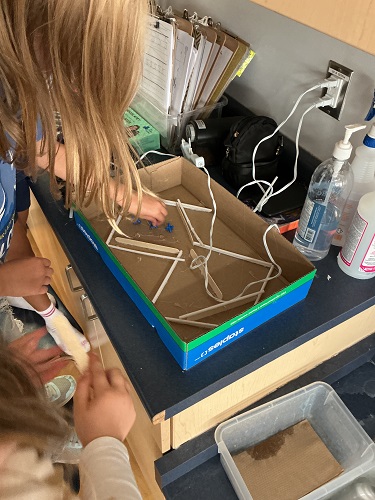 their mazes were complete, they took turns testing them, sharing their ideas, and celebrating the features they had created. It was exciting to observe the children collaborating, communicating their plans, and working through challenges together. These interactions supported a sense of belonging as the children contributed to a shared goal, while also providing opportunities to practice patience, cooperation, and respect for one another's ideas. Their pride in their completed creations reflected the confidence that can grow when children are given opportunities to make decisions, solve problems, and see their ideas come to life.
To conclude our marble exploration, the children experimented with marble painting. Using flat trays and trays with raised sides, they placed small dots of paint across their paper with spoons before adding marbles. As they moved the trays, the marbles travelled through the paint, creating different lines, patterns, and designs. Each child approached the experience in their own way. Some moved their trays from side to side, spreading paint a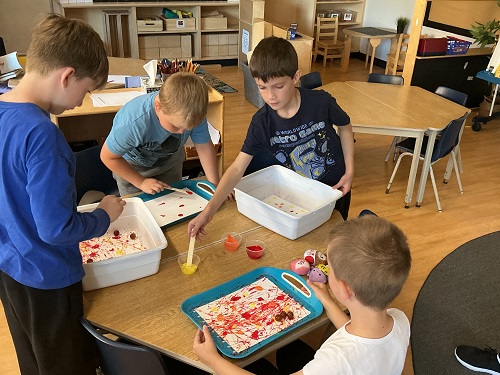 cross most of the paper, while others intentionally left white spaces to highlight the trails left by the marbles. Some children discovered that shaking the tray created interesting patterns, while others enjoyed moving it up and down, causing the marbles to bounce and leave small dots across the page. The children experimented with different techniques, made independent choices, and discovered how their movements influenced the final result. This experience offered another opportunity for expression, allowing each child to communicate their ideas and creativity through art in a way that reflected their individual preferences.
Throughout our marble exploration, we observed the children revisiting familiar ideas, developing new theories, testing possibilities, and expressing themselves through a variety of materials. What began with one child's suggestion grew into an extended investigation involving construction, imaginative storytelling, mathematical thinking, scientific inquiry, collaboration, and creative expression. The children's experiences reflected the four foundations of How Does Learning Happen?: belonging, as they shared ideas and built relationships; well-being, as they developed confidence and persistence; engagement, as they remained curious and actively investigated their questions; and expression, as they communicated their thinking through words, building, storytelling, and art.
As educators, we will continue to observe the children's interests and build upon their ideas by offering new materials and opportunities for investigation. We wonder what might happen if the children experimented with ramps of different heights, surfaces with varying textures, or longer and more complex pathways. We could also invite them to draw their designs before building, make predictions about which structures might work, and revisit their ideas after testing them. By remaining curious alongside the children, documenting their discoveries, and providing opportunities to revisit and extend their thinking, we can continue to nurture meaningful learning experiences that emerge from their interests.
This experience reminded us that learning does not always begin with a planned activity. Sometimes, it begins with a child's memory, a question, or an idea. When we listen, respond, and provide opportunities for children to explore, we create an environment where their curiosity is valued, their relationships are strengthened, and their learning can grow in unexpected and meaningful ways.