


Over the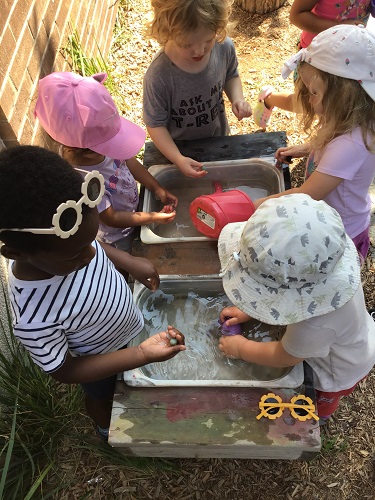 past few weeks, the preschool children have been deeply engaged in a variety of sensory activities that spark curiosity, encourage self-expression, and nurture their understanding of the world around them. Throughout the summer, they’ve immersed themselves in rich sensory exploration and hands-on learning opportunities that support their cognitive, social, emotional, and physical development. Whether it’s squishing, pouring, mixing, or creating, each activity invites them to learn through play, build essential life skills, and grow with confidence and joy.
In our vibrant preschool classroom—both indoors and outdoors—a group of curious and energetic children have been deeply engaged in sensory exploration on a daily basis. Each day begins with excitement buzzing in the air, as children pour into the classroom, eager to dive into new hands-on experiences that awaken their senses and imaginations.
One bright morning, the children participated in a fun and colorful experiment, creating their very own foamy mixture using baking soda, vinegar, and dish soap. Rose was especially excited and couldn’t wait to join in. After feeling the foam in her hands, she exclaimed, “It’s like magical foam! It feels so soft and foamy!”
Recognizing the children’s interest in color and texture, we brought painting supplies outside on another sunny morning. The children decided together to transform the sidewalk into a giant rainbow. Working as a team, they spread vibrant colors across the pavement. After completing their masterpiece, they eagerly asked the educator to write their names alongside the rainbow. Inspired by this, a group of children began writing letters from their own names, proudly pointing out the ones they had in common. This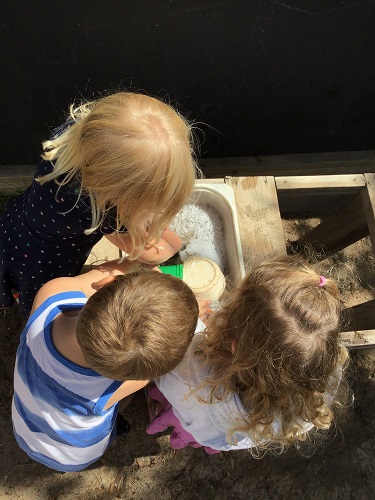 playful literacy activity not only boosted their language development but also supported their fine motor skills as they carefully painted with their brushes.
Water play has also been a favorite sensory activity this summer. The children explored it in many creative ways—mixing it with paint, soap, and even adding shells to create bubbling, colorful concoctions. They delighted in blowing bubbles and watching them float through the air in shimmering hues.
On another morning, the children ventured into the natural playground to collect items like leaves, corn tufts, sticks, and rocks. Using spray bottles filled with colored water, they arranged their natural treasures on white paper to create beautiful nature-inspired art. Joanne was fascinated by how the droplets ran down her leaf, observing thoughtfully, “They look like rainbow bubbles!” It was a magical moment that combined art, science, and nature.
Another engaging experience involved Felix, Penelope, and Zyan collecting rocks and observing how they changed when placed in water. “We want to see how they look like,” they said with curiosity. This simple activity sparked observation, prediction, and early scientific thinking.
Later, we introduced a creative dramatic play experience by transforming a large cardboard box into a lemonade stand. This hands-on activity allowed children to role-play, buy, sell, and use pretend money—developing math, communication, and social skills along the way. Lucy shared, “I got two cups of lemonade and it’s delicious,” while Claire added, “I got money and I can get more refills.” Rose made a silly face and exclaimed, “It’s sour!” The children enjoyed the sensory fun of tasting (pretending to taste) and the real-life learning th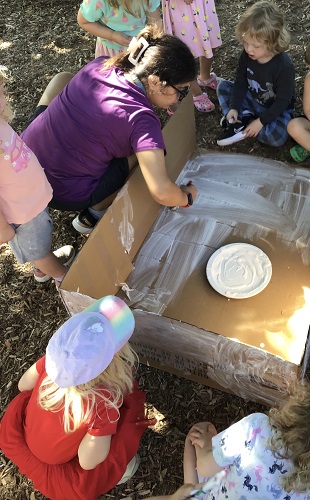 at came with it.
To build on their interests, we turned the other half of the cardboard box into a car wash, complete with sprinklers on the sides. Children took turns riding their bikes through the watery tunnel, squealing with laughter as they experienced the cool spray. It was a fantastic blend of movement, water play, and imagination.
Throughout these experiences, it has been truly wonderful to see the children so engaged and focused—deeply immersed in activities they love. These sensory-rich moments foster not only joy and creativity but also build the foundation for essential life skills. Through exploration and play, the children are developing cognitive, social, emotional, and physical strengths. Most importantly, they are growing more confident and capable, ready to take on new learning experiences with curiosity and enthusiasm.
The children learned how different textures, smells, and visuals can interact (e.g., “magical foam,” “rainbow bubbles”).
Through the lemonade stand activity, children explored:
- Counting
- Money exchange (using pretend bills)
- Sequencing (order of serving, buying, etc.)