


Over the past few weeks, the children engaged in a variety of team building activities that encouraged collaboration, problem-solving, and communication. Through both self-initiated and guided play experiences, they discovered the value of working together toward a common goal while strengthening important social, emotional, cognitive, language, and physical skills.
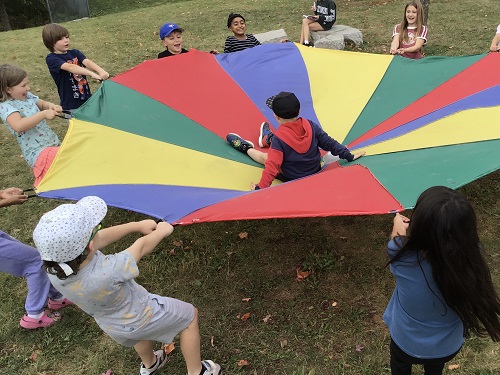 It began when the children found a large parachute in the outdoor wagon and decided to explore it together. Each child grabbed a handle, and they began tossing balls on top, laughing as they tried to keep them from falling off. Their communication and cooperation grew as they called out instructions and worked in unison.
When Almalinda suggested someone sit in the middle, the group experimented with different ways to lift their peer off the ground. After several attempts, they realized that by counting together “1, 2, 3, pull” and pulling at the same time, they could lift the person slightly into the air. The children were thrilled and proud of their success, celebrating what they were able to achieve together.
Through this experience, they developed social and emotional skills by cooperating and building trust, enhanced communication through planning and teamwork, strengthened cognitive understanding of cause and effect, and supported gross motor coordination and strength through active movement.
During outdoor play another day, several children asked to go inside to complete their homework. Once inside, they formed a Homework Club, setting up their materials and helping each other with spelling and writing.
“Can you help me make a sentence with the word quickly?” asked Emerson.
“How do you spell shoes?” asked Ethan.
“I’m good at spelling — I can help” responded Riggins with enthusiasm.
The group worked together, offering encouragement and guidance as they completed their assignments.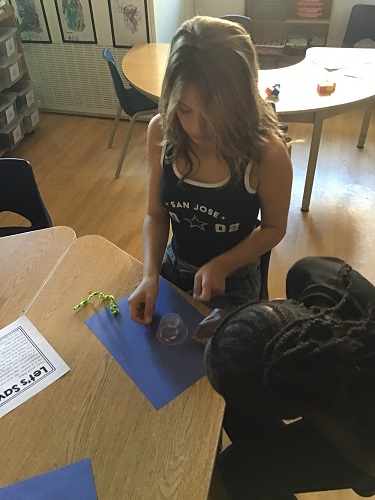
This collaborative time supported cognitive development through literacy and problem-solving, social development through cooperation and peer support, and emotional growth as they built confidence and pride in their abilities. Their communication skills were strengthened as they learned to ask for help, share ideas, and explain their thinking.
In the following days, the children participated in a STEM-based challenge called Save Fred. Using a pipe cleaner “snake,” a cup, and paper clips, they were tasked with rescuing Fred’s life preserver without touching any objects with their fingers.
They eagerly worked together, discussing strategies, testing ideas, and learning through trial and error. When they succeeded, shouts of “I saved him!” and “We did it!” filled the room, followed by laughter and excitement as they repeated the challenge.
This hands-on activity fostered cognitive development as they planned, tested, and adjusted their approach, supported social skills such as cooperation and teamwork, and encouraged emotional resilience through persistence. The challenge also refined their fine motor coordination as they carefully manipulated the paper clips.
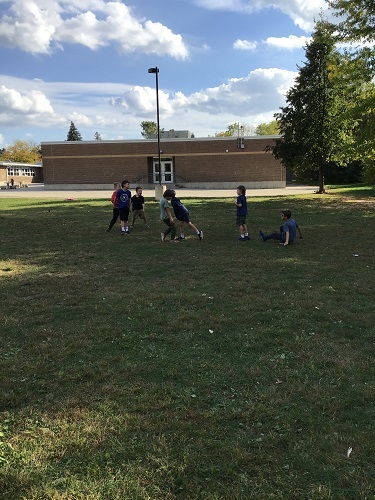 The next week, Colton suggested playing Red Light, Green Light outside. A few children joined in, and Layla and Brielle, who didn’t know the rules, were guided by their peers. The group made sure everyone understood and took turns being the “caller.” They practiced listening carefully, following directions, and cheering one another on.
This simple yet meaningful game strengthened cognitive skills such as listening, focus, and self-regulation. It enhanced social development through turn-taking, fairness, and inclusion, and improved physical coordination and body control through quick, controlled movements. The laughter and encouragement shared among the group built strong emotional connections and positive peer relationships.
While some were playing red light green light, a small group of girls set up their own Hair Salon, taking turns as stylists and clients. They chatted as they brushed and braided hair, offering compliments and sharing stories. What stood out most was how children who don’t often play together began engaging and forming new connections.
This dramatic play experience nurtured social and emotional development through empathy, cooperation, and friendship building. Their cognitive development was supported through sequencing and imagination, while fine motor control was enhanced through the detailed actions of brushing, clipping, and styling.
In the coming weeks, what started as a few classmates collecting sticks evolved into a fort-building project that soon involved nearly the entire class. The children collaborated to carry large logs, gather branches, and plan how to arrange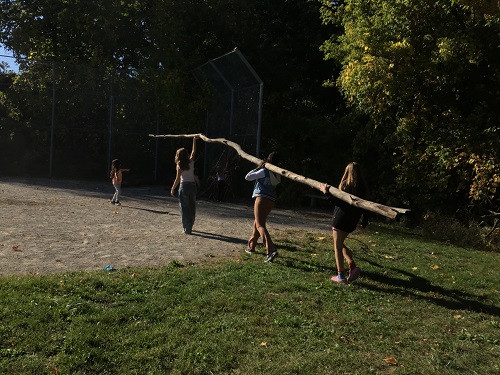 materials to create their shelters. They discussed ideas, problem-solved together, and celebrated as their forts took shape.
This spontaneous experience became a powerful example of teamwork and perseverance. It promoted cognitive development through planning, spatial awareness, and early engineering concepts, strengthened social and emotional skills through cooperation and shared achievement, enhanced physical abilities through lifting and balancing materials, and fostered communication and leadership as the children organized and directed the work together. They have had a growing interest with the fort building and have continued this play for weeks.
Across all of these experiences, the children demonstrated remarkable growth in teamwork, problem-solving, communication, and self-regulation. They are learning that working together not only helps them reach goals more effectively but also strengthens friendships, builds confidence, and fosters a sense of belonging within the group.
Moving forward, we wonder how else we can engage the group as a whole and continue to strengthen their teamwork and social skills through shared challenges, imaginative play, and outdoor exploration.
We will continue to encourage team building activities that promote cooperation, creativity, and positive social connections.