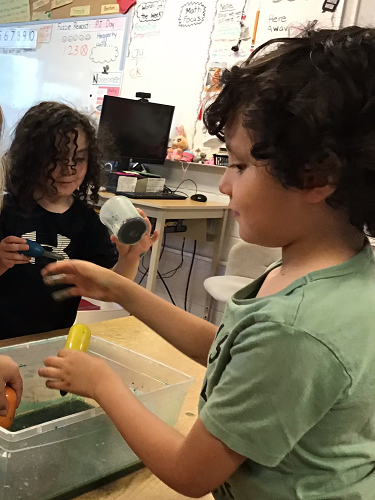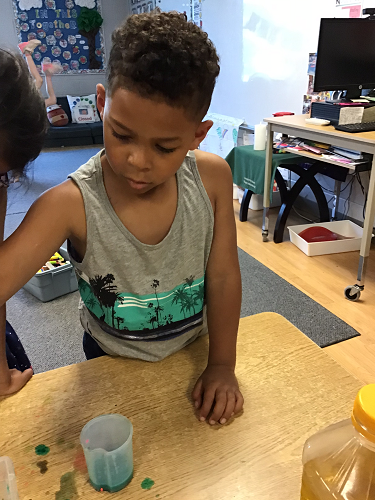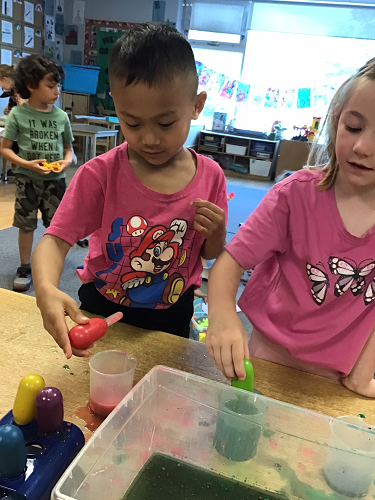


This month at RisingOaks Early Learning | Saint John Paul II, the School-age 1 children have been interested in science activities. So, as the day became warmer, we decided to do our science experiment inside the class. Some children settled down for a snack, while others gathered with excitement and curiosity around a table filled with intriguing materials like: clear containers, droppers, acrylic paint, water, and oil. The materials immediately sparked conversation and guesses. I asked, “What do you think we’re going to do?” “Cupcakes” said Zoey, smiling. “Painting” guessed Charli with confidence. The children were clearly curious and ready to explore. In small groups, they helped pour oil into the clear containers. Meanwhile, I mixed water and acrylic paint in four separate cups, creating vibrant pink, black, and green solutions. Each child eagerly took a turn using a dropper to add coloured water into the containers filled with oil. As the children watched closely, colourful drops floated through the oil, forming bubbles that danced and slowly sank. I asked “What do you see, friends?” “Bubbles” exclaimed Aeddan, fascinated. “Why did the water and oil separate?” asked another child. This created a perfect moment for scientific explanation in child-friendly language: I answered, “That’s because of density. Water is heavier than oil, so it sinks. Also, water and oil don’t mix because they don’t attract to each other”. The children continued to experiment adding more drops, swirling the containers gently, and combining colours. They noticed that the droplets of coloured water stayed together in the oil, creating mesmerizing bubble-like shapes. Some children commented on the changing colours, while others observed how the droplets moved differently than water alone. They were excited to touch the oil and water mix. Anna touched with fingers exclaimed, “gooey”. This water and oil science experiment supported children's understanding of density, provided hands-on learning, encouraged critical thinking, fostered creativity, and helped build confidence and self-esteem. It also improved their fine motor skills and much more “When we recognize children as capable and curious, we are more likely to deliver program and services that value and build on their strengths and abilities” (Ministry of Education, 2014, p. 6)