As part of our reflective practice and DEIB initiatives, School-age 1 is continuing to explore culture through activities, but has added a "word of the week" to enhance on this interest. We started by asking the children and our families which languages they spoke at home or were significant to their family. We were given some great insight into the cultural diversity in our class, and chose to begin with Italian!
To start us off, we took the opportunity to make pasta with playdough! Initially we had planned to make standard egg-pasta by making playdough with yellow food colouring and invited the children to have the opportunity to learn about different pasta shapes; this turned into the children trying to make their own shapes as well. As we began to mix the playdough ingredients, we used visuals to show the children different shapes. We showed them pictures, had them guess what they thought it was called, and then practiced saying the name together. A few of them were easy, like macaroni because the children were able to relate it to Kraft Dinner and Macaroni and Cheese; while some of them were harder and needed a little more practice with the pronunciation, like orecchiette. Our favourite moment from this part of the activity was when we came across bowtie pasta and Grayson guessed that it was called "angel wings", likely because of the shape, and we had reviewed another pasta called "angel hair". Educator Barbara then was able to tell us that it is also called farfalle, which means butterflies.
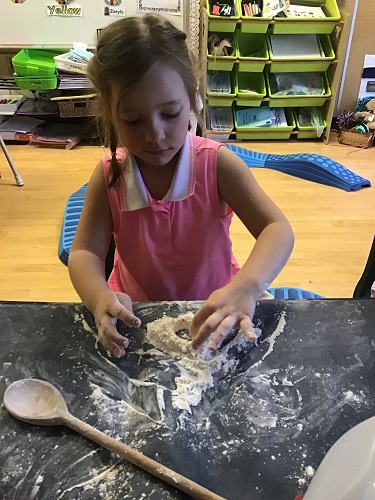
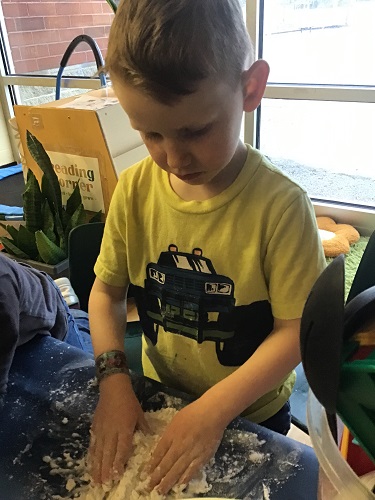
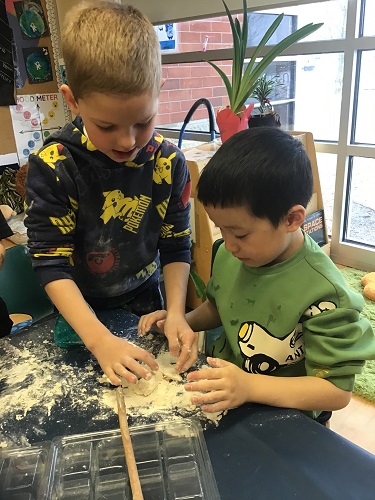
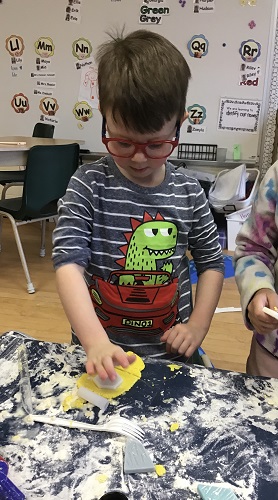
After we reviewed some of the established shapes, we continued making our playdough which ended with some extra flour on the table. Noah started to scoop the flour with his hands and we extended his movements by dumping more flour on the table and learning how to mix pasta dough properly. We showed the children a visual of a large flour well filled with eggs and talked about how this is the beginning when making pasta dough at home. The children immediately noticed the eggs in the example and exclaimed that we can't have that because we have a child with an egg allergy in our class. They wanted to make sure that the child could be included and also be kept safe during the experience. We problem-solved by using a little salt (as a thickener), water (to act as a viscous egg white), and some of our freshly made yellow playdough (to represent the egg yolk). The children worked on kneading their dough, and slowly adding more water to their very floury dough. Eventually the children created a working dough and used caps, playdough tools, stone moulds, forks, and butter knives to cut and manipulate their dough into pasta shapes!
As the first group of children finished up with the activity, we repeated it multiple times for anyone that wanted a turn at the pasta station. Noah was so engaged and asked to help each new set of children create their wells and explain how we were going to substitute for the eggs in the photo. What started out as a shape making activity, turned into a full-on pasta making workshop! Some of the children asked to send the recipe to their parents so they would be able to make pasta at home! We will continue incorporating more Italian-inspired activities over the next few weeks before moving onto our next language!