In our after-school program, when we have lower numbers, we usually combine both rooms. This allows the younger and older children to have time with together, building friendships, engaging in new activities and supporting each other’s development.
Interactions between school-age children and kindergarteners provide valuable opportunities for growth and learning for both age groups. Through shared play, conversations, and cooperative activities, children develop important social, emotional, cognitive, and language skills.
School-age children often take on leadership and mentoring roles when interacting with younger children. They learn to demonstrate patience, empathy, responsibility, and effective communication as they explain rules, offer assistance, and model appropriate behaviours. These experiences help strengthen their confidence, self-esteem, and problem-solving abilities.
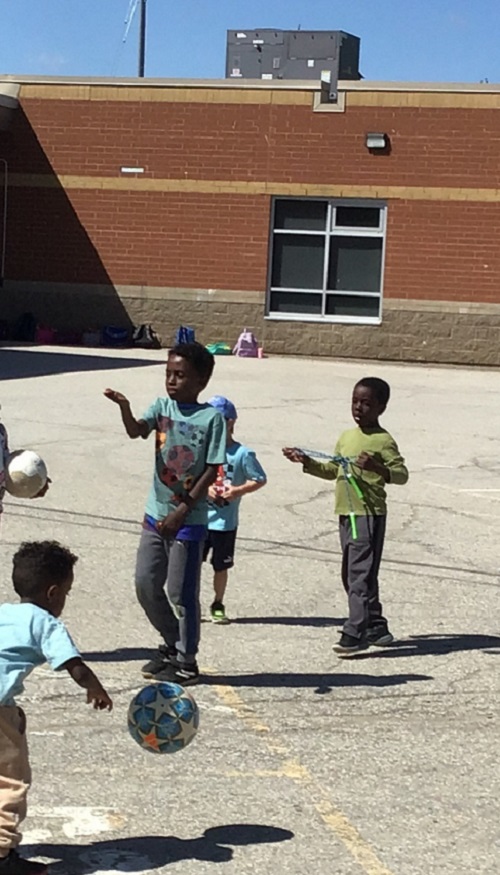
When we combine, we usually say outside the whole afternoon; and now that we are on the last weeks of school, children already made their groups. One of those is lead by Yoel, who plays for hours and hours with Michael, Moyosola, Rosa, Julian, Luca and Noel. Usually, Yoel is the person that has the leading role: catching the others during tag games, giving them instructions and explaining how the game will work. They run around, hide from each other; and you can hear their giggles from far away.
Kindergarteners benefit from observing and interacting with older peers. School-age children serve as positive role models, helping younger children develop social skills such as sharing, turn-taking, cooperation, and conflict resolution. Kindergartners are often motivated to try new activities and build independence when encouraged by older children.
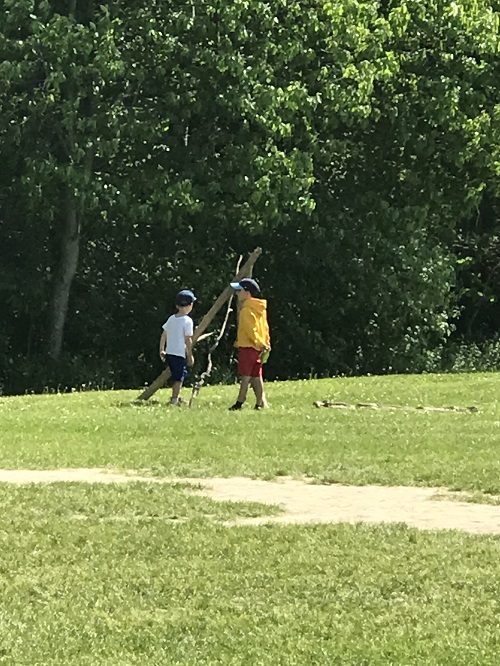
One of these afternoons, Gavin observed Samuel, Reid and Wyatt gathering sticks to make a tent and decided to help. They all worked together collaborating to make the tent big enough to at least two people at a time could be inside. This supported their social, gross motor and emotional skills as they collaborated, took turns, problem-solved together and were very proud of themselves and their work.
These interactions also support language development. Through conversations, storytelling, and collaborative play, children expand their vocabulary, improve listening skills, and learn how to express their thoughts and ideas more effectively.
Cognitively, mixed-age interactions encourage creativity, critical thinking, and learning through observation. Older children reinforce their own knowledge by teaching concepts to younger peers, while kindergarteners gain exposure to new ideas and skills that may be slightly beyond their current developmental level.
Socially and emotionally, relationships between school-age children and kindergarteners help foster a sense of belonging, inclusion, and community. Children learn to appreciate individual differences, build friendships across age groups, and develop respect for others.
Overall, interactions between school-age children and kindergarteners create meaningful learning opportunities that support whole-child development, promoting social competence, emotional growth, communication skills, leadership, and positive peer relationships. Also preparing them for their summer camp experience, as we have a mixed room with kindergarteners and school-agers.