In child care, everything that occurs, can be a learning opportunity. One day at RisingOaks Early Learning I St Nicholas Preschool, towards the end of the day, the educators and children were tidying up the toys together. Educator Sue folded up a torn cardboard box to put it in the recycling bin. Kali-Ann saw this, quickly ran over, and cried out, "Sue, this is my house!" She looked incredibly sad. Her dad arrived to pick her up right at that moment, and she tearfully complained to him that her house was gone, even though she knew it was just a broken box. I walked over and explained what had happened to her dad, he smiled. I then said, "This house was broken, but I promise I will get you and your friends a better one." Her dad smiled again and said, "That's right, you'll all get a new house." She felt satisfied after hearing this and left happily with her dad. Based on this incident, Sue gathered a few boxes and organized opportunities to create several items of interest.
A house project:
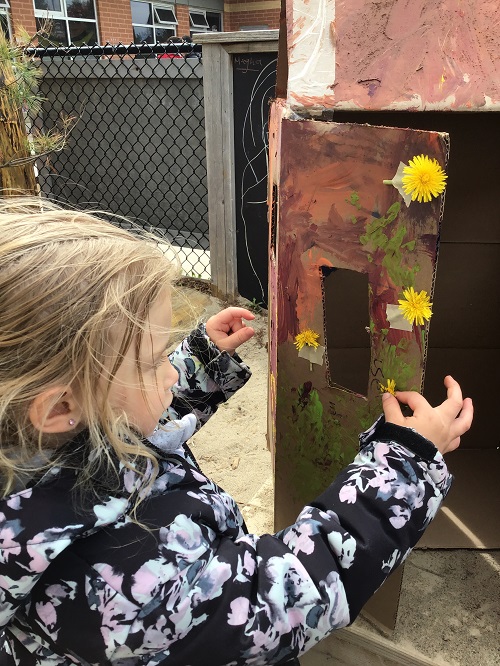
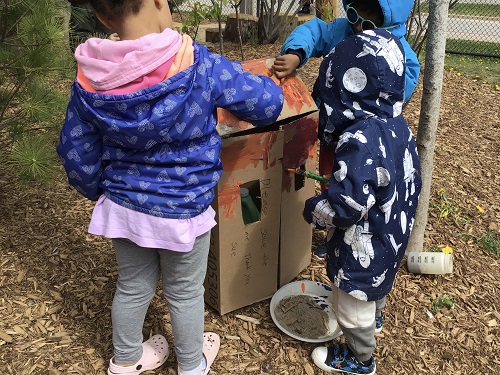
Educator Sue made a cardboard box into the shape of a house, using a knife to carve windows into both sides and cutting out a functioning door on the front. We placed the house outdoors and provided the children with an assortment of paints and differently shaped brushes. Upon seeing the setup, the children eagerly selected their preferred colors and brushes, painting the house with vibrant hues. Kali-Ann, in particular, was overjoyed that Sue had kept the promise to her. She even picked some dandelions to place on top, beautifully decorating the little house. Opening the door, she sat inside, her face beaming with pure joy. When she noticed Miles standing outside, his expression clearly reflecting his own desire to go in, she crawled out and said, "It's your turn." The two of them then shared a warm smile, as they practiced turn taking.
The School Bus Project
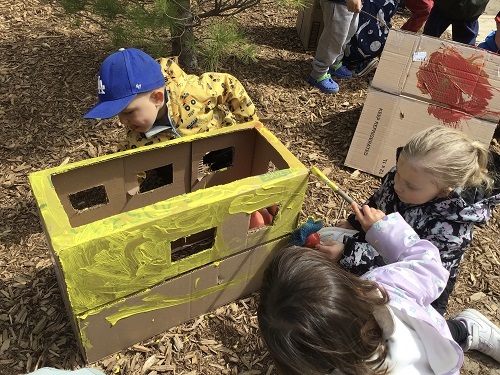
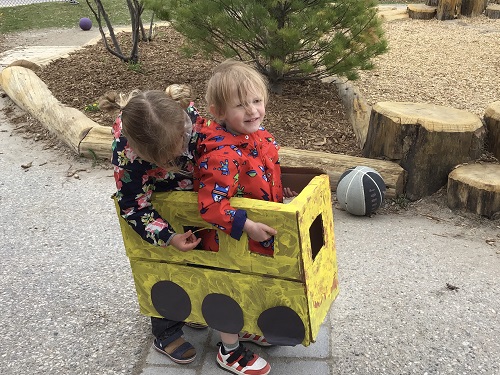
Every afternoon during outdoor playtime, the children observe school buses arriving to pick up students from the school, which has developed a strong interest in them. Hendrix, in particular, proudly shared with his friends that his daddy drives a school bus. Inspired by this, Educator Sue took a rectangular cardboard box and cut out several square "windows" and a functional "door." Yellow paint and crafted "wheels" out of black construction paper were provided. Noemie, Roman, and several other children chose the yellow paint, stating, "I like school buses." They then proceeded to paint the box with meticulous care. Once the paint had dried, the children eagerly took turns acting as the driver of their new "school bus." Summer and Bryson drove the bus together. As they were "driving," Summer lowered her head to examine something intently; We imagined she was conducting a safety inspection. Kali-Ann took her turn at the wheel just as the real school buses arrived to pick up students. She steered her "school bus" close to the fence with a gentle smile, her proud expression seeming to say that she, too, knew how to drive a school bus. Hendrix, Abigail, Noemie, and the rest of the children also enjoyed their turns driving.
A triangular tent or treehouse
Additionally, inspired by the children's daily conversations, we constructed a triangular tent—which some children referred to as a treehouse. Sue affirmed whatever the children chose to call it, recognizing that it reflects their understanding of their everyday lives. The children then painted the structure in vibrant colors and eagerly crawled inside, fully immersing themselves in this small but highly imaginative space.
We left them outdoors to share with children from other classrooms. Sree, the educator for the school-age program, mentioned that the children in her class also thoroughly enjoyed them and had a wonderful time playing.
Recycled cardboard boxes, especially large ones, are among the most magical "loose parts" in early childhood education. When children gather around, attempting to transform an ordinary box into a house, a vehicle, or a treehouse, they are actually engaging in profound, interdisciplinary learning. Unlike commercial toys, which typically have fixed functions (a toy car is always just a car), cardboard boxes are inherently open-ended. A simple box can become a house that shelters friends from the elements, a school bus, or a treehouse. This creative process of turning "nothing" into "something," along with the ability to assign new meaning to inanimate objects, represents a crucial milestone in the cognitive development of preschool children. Simultaneously, this shared experience significantly enhances their collaboration and turn-taking skills.
Our next step is to encourage the children to independently cut windows, doors, and wheels from various kinds of paper, allowing their interpretations of items to come to life as this will effectively develop their fine motor and hands-on skills.